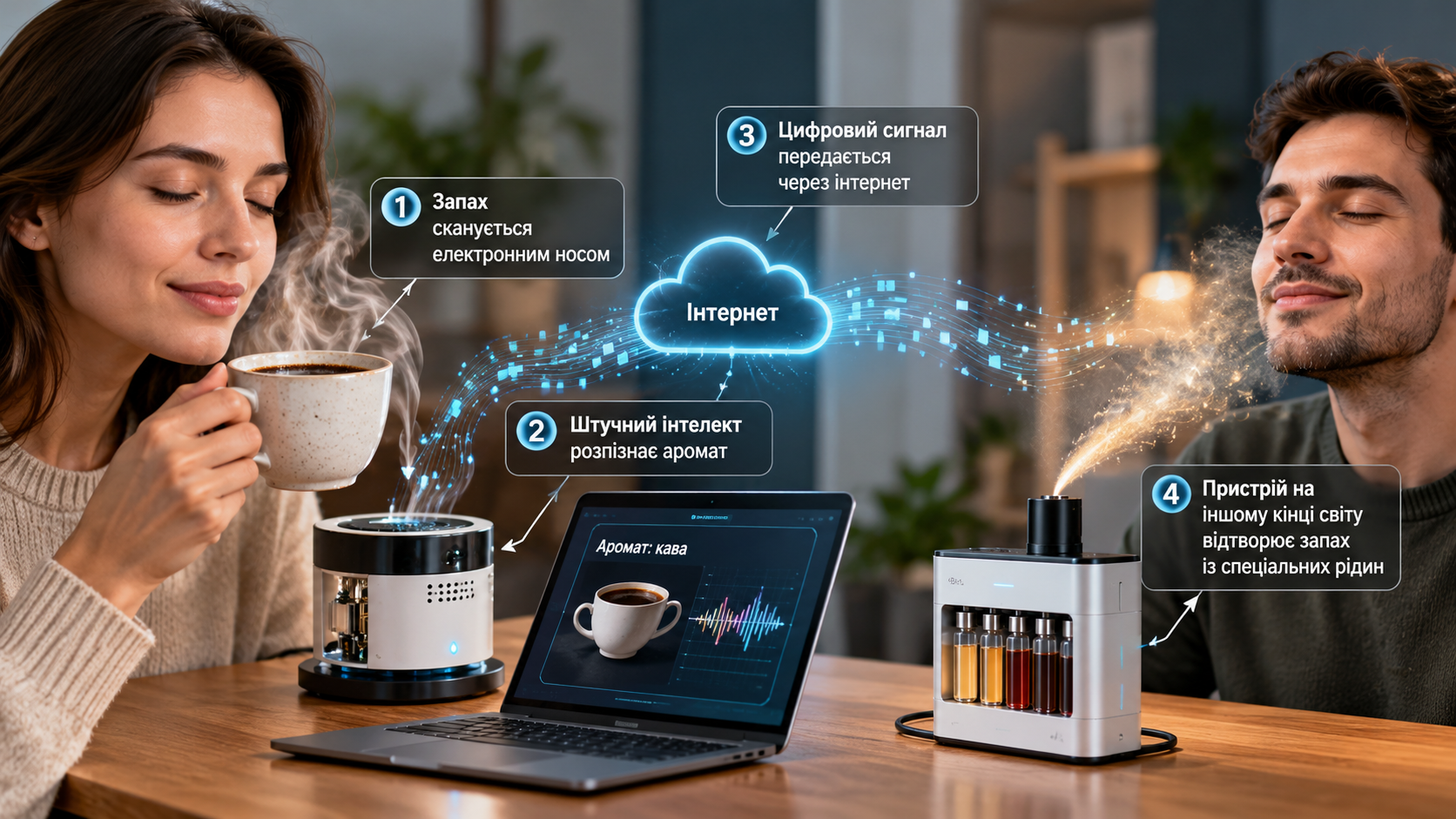
American and Chinese researchers have developed Scentronic technology, which enables odours to be recognised using artificial intelligence and reproduced remotely via the internet. A special electronic nose identifies the scent, transmits a digital signal, and the recipient’s device releases the corresponding aromatic substance. At present, the system only works with five scents, including coffee, beer and orange. The research findings were published on 21 October in the scientific journal *Science Advances*.
- Researchers have developed Scentronic — a system for the remote detection and reproduction of odours.
- Artificial intelligence identifies the scent, and a special device recreates it using scented liquids.
- The prototype works with five scents: coffee, beer, red wine, cake and orange.
- During the experiment, 14 volunteers correctly identified the odours presented on approximately 73% occasions.
- The technology is being considered for online shopping, virtual reality and medical research.
How scientists have learnt to transmit smells over the internet
The system Scentronic It was developed by researchers at Ohio State University in the US, in collaboration with scientists from the Zhejiang Laboratory in China. Their aim was to develop a technology capable of enhancing ordinary digital communication with another human sense — the sense of smell.
The principle behind the device starts with an ‘electronic nose’ — a device approximately 15 centimetres in diameter. Inside are gas sensors that react to the volatile chemical compounds that give food and other substances their smell.
The sensors generate a distinctive set of electrical signals. The machine learning algorithm analyses this data and determines which of the categories known to it the aroma belongs to.
The information is then transmitted via the internet to another device. This device uses pre-prepared scented liquids and miniature atomisers so that the person can experience the corresponding scent.
An important feature technologies The principle is that it is not the scent itself that is transmitted via the internet, but digital information about it. The molecules of the aromatic substances are already present in the recipient’s device.
What scents can Scentronic reproduce?
Researchers have now trained the system to recognise five common scents:
-
freshly brewed coffee;
-
beer;
-
red wine;
-
cake;
-
orange.
These scents were chosen for their recognisability and differences in their chemical characteristics. The scientists also tested the simultaneous reproduction of two scents, specifically coffee and orange, and beer and cake.
Fourteen volunteers were invited to test the technology. The participants were asked to identify the scent emitted by the device without knowing the correct answer in advance.
The results showed that People correctly identified certain odours in 72.86% cases. When the system reproduced two scents simultaneously, the accuracy was 71.43%.
The electronic nose itself was able to distinguish between five categories of odours with an accuracy of over 96%. The difference between these figures is due to the fact that machine recognition and human perception of a reproduced odour are two separate processes.
You’ll be able to smell scents through a bracelet or pendant
To reproduce scents, the team has developed several compact devices. Among the experimental designs are a wristband, a pendant and a portable device that can be held in the hand.
Inside are small reservoirs containing scented liquids. Piezoelectric elements generate vibrations which cause the liquid to break up into tiny droplets and be released into the air.
The researchers also created an experimental cup capable of combining smells with taste sensations. During a mixed-reality demonstration, users were able to select a virtual drink and receive a corresponding aroma and flavouring.
The technology is not yet capable of accurately reproducing every scent in the world around us. For each new scent, the algorithm needs to be trained further, and the receiving device must be supplied with the appropriate aromatic substances.
Will it be possible to smell food through a smartphone screen?
The authors of the study consider several possible applications for Scentronic. One of these is online shops, where customers will be able to experience the scents of perfumes or food products remotely.
Another area is video calls. For example, a person will be able to show their friends a dish they have just cooked, and a compatible device on the other side of the world will release the corresponding scent.
In virtual and augmented reality, smells can complement visuals and sound. Researchers are also exploring the potential use of this technology for testing the sense of smell and for sensory rehabilitation.
However, Scentronic remains a laboratory prototype. Before it can be used commercially, the range of available scents needs to be expanded, the accuracy of their reproduction improved, and the devices tested in everyday conditions.
For the time being, a smartphone cannot reproduce smells on its own: this requires additional equipment containing scented liquids. However, the experiment has shown that transmitting information about a smell over a distance and physically reproducing it are already technically possible.