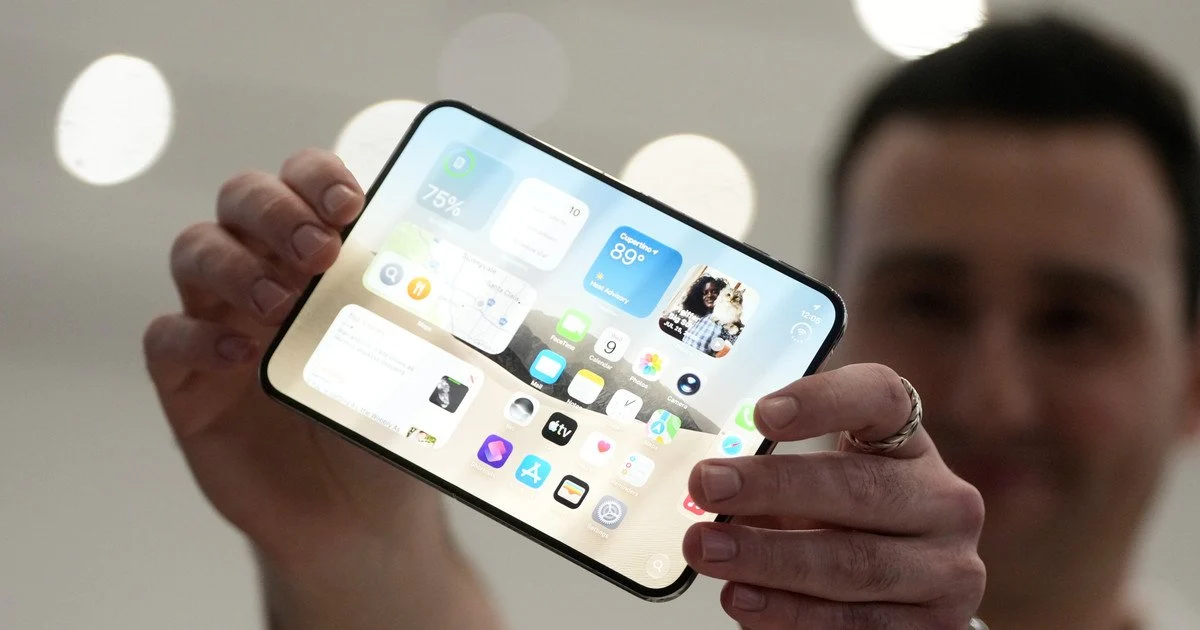
Apple unveiled the first foldable iPhone Duo as one of the most premium smartphones in its history. However, following the first hands-on tests, journalists have already highlighted some compromises: the absence of Face ID and a proper telephoto lens, a crease in the display that is noticeable from certain angles, limited multitasking, and a weight of 254 grams. That said, it is too early to talk of widespread «bugs» — the iPhone Duo has not yet gone on sale, and comprehensive independent tests are still to come.
- The iPhone Duo costs between $1 999 and $3 199 in the US.
- No Face ID — Apple has brought back Touch ID in the side button.
- There is no separate telephoto lens; the 2x zoom works via the main camera.
- The crease on the inner display is almost imperceptible, but it is still there.
- Two programmes can only be run side by side in a fixed 50/50 split.
- The smartphone weighs 254 g and is 11.3 mm thick when folded.
The iPhone Duo hasn’t been released yet, so the «user reviews» are still speculative
After iPhone Duo presentations A large number of articles about the new product’s «problems» and «bugs» have already appeared online. However, there is an important point to note here: The smartphone isn’t on sale yet.
Pre-orders in the US will only open 16 October, and the first customers will receive their devices on 23 October. Therefore, at this stage, we can only draw on the impressions of journalists who spent a few dozen minutes or hours testing the demo units following Apple’s presentation.
Widespread problems with the battery, hinge, display or iOS 27.1 It will only be possible to assess this once sales have begun.
That said, even a brief hands-on test was enough to spot a few compromises which, for a smartphone costing $1 999, could prove to be significant.
The first surprise is that the iPhone Duo doesn’t have Face ID
Apple’s most unexpected decision — the decision to abandon Face ID.
The iPhone Duo uses Touch ID, built into the side button. Apple explains that this is because a fingerprint is convenient to use regardless of whether the smartphone is open or closed. You can also unlock the Duo via an Apple Watch.
Technically, the solution makes sense: the complex design leaves less space for the TrueDepth system.
But for a buyer paying nearly $2,000, the situation seems rather unusual. For years, Face ID has been a standard feature on high-end iPhones, whilst the new top-of-the-range model is reverting to a fingerprint scanner.
It’s not a «bug», but it’s certainly one of the most noticeable compromises.
The $1 999 does not have a separate telephoto camera
The second compromise concerns the cameras.
Apple has fitted the Duo with two main 48-megapixel cameras: a wide-angle and an ultra-wide-angle lens. The claimed 2x Telephoto It is produced using the central section of the main 48-megapixel camera’s sensor — the smartphone does not have a dedicated telephoto lens.
By way of comparison, buyers of the iPhone 18 Pro get a more advanced camera system.
After reviewing the Duo, The Verge also noted that the cameras on the first foldable iPhone are not the device’s main technological selling point: Apple has clearly focused on the display, the hinge and the software.
For the average user, 2x may well be enough. But in a smartphone which, in its top-of-the-range configuration, costs $3 199, the lack of a separate TV set is particularly noticeable.
Apple hasn’t completely overcome the display crease
It was the fold in the inner display that attracted the most attention following the presentation.
Apple has incorporated a special nano-textured polymer layer, a new OLED panel structure and a complex hinge. The result is truly impressive.
Following its test, MacRumors notes that the crease much less noticeable, compared to many rival foldable smartphones. You can hardly feel it when you touch it. Tom’s Guide also gave the design a positive review: the journalist could barely feel the crease with his finger.
But physics hasn’t gone anywhere.
At a certain angle and under the right lighting conditions the crease is visible after all.
The main question now is a different one: what will the display look like a year from now, after tens of thousands of opening and closing cycles?.
Multitasking is available, but it’s simpler than on the iPad
Apple It actively promotes the 7.6-inch internal display as a tool for multitasking.
Indeed, the Duo became the first iPhone capable of running two programmes side by side.
You can open Messages and Safari at the same time, or two Safari tabs, or create permanent app pairs. However, journalists have uncovered a significant limitation.
The size of the windows cannot be changed. The display is always split roughly in half, with a 50/50 ratio. It is not possible to drag the centre line and allocate, for example, 70% of the screen to a single app, as you can on an iPad.
For the first version of iOS on the foldable iPhone, this is an understandable compromise, but it is precisely from a device with such a large screen that many users will expect near-tablet-level multitasking. That isn’t available yet.
A hidden camera isn’t actually always hidden
Internal FaceTime camera is located beneath the display.
Against a light background, it practically disappears, giving the large screen a very clean look.
But MacRumors pointed out: Against a dark background, the area beneath the camera can still be seen.
It’s a minor detail, but it’s yet another example of how even Apple has not yet managed to completely eliminate the technical compromises involved in a complex display.
254 grams — that’s quite a lot
The Open Duo is only 5.2 mm, which allowed Apple to call it the thinnest iPhone. But when folded, the smartphone is already 11.3 mm, and weighs 254 grams.
The Verge notes that, in terms of hardware, the Duo does not necessarily outperform its latest rivals: there are already foldable models on the market with slimmer bodies, lower weight and higher-capacity batteries. In other words, whilst the Duo is indeed extremely thin when unfolded, users will mainly carry it in their pocket compiled. And there, the advantage is no longer so obvious.
eSIM only — even outside the US
Standard American iPhones have long since switched to eSIM, but Duo has taken it a step further. There is no physical SIM slot in any country.
Apple says this has freed up more internal space for batteries. The Duo can store at least eight eSIMs and use two at the same time.
In the US, this is unlikely to be a major issue: AT&T, Verizon and T-Mobile have long supported eSIMs. However, for people who frequently travel to countries where physical SIM cards are still more common, this solution may cause additional inconvenience.
The battery remains a major question mark for the time being
Apple states that by 31 hours of video playback on the internal display, 44 hours on the external display, and around 24 hours of mixed use.
The Duo features an unusual design with two batteries – one in each half of the case. However, there are as yet no independent, comprehensive battery life tests.
The Verge explicitly states that the battery’s actual performance under sustained use remains one of the questions that a brief hands-on with the device fails to answer. It will be particularly interesting to see how long the battery lasts when running two apps simultaneously on the 7.6-inch screen, with the display set to high brightness and 5G enabled.
So where are the bugs in iOS 27.1?
Whilst the journalists do not indicate any serious system-wide problem, which would already suggest that the iPhone Duo has critical software bugs. On the contrary, one of the most positive aspects of the initial reviews is the software itself.
The Verge highlights the very seamless transition between the external and internal displays, the specially redesigned iOS 27 interface, and the different usage modes of the half-open smartphone.
MacRumors also gives a positive review of the app redesign and the new vertical Dock. Hence headlines such as «A whole host of bugs have been found in the iPhone Duo» would be an exaggeration at this point.
The real test will begin on 23 October, when tens of thousands of devices will be made available to ordinary users.
The biggest problem may not be technical at all
Even if Apple has managed to create one of the best-designed foldable smartphones, the question of price remains.
In the US, the official range is as follows:
| Memory | Price |
|---|---|
| 256 GB | $1 999 |
| 512 GB | $2 199 |
| 1 TB | $2 599 |
| 2 TB | $3 199 |
For $3 199, the buyer gets a phone that costs more than many MacBooks, yet lacks Face ID, a dedicated telephoto camera and full-fledged tablet-style multitasking.
That is why the question «Is the iPhone Duo worth the money?» may be more important than the question of its fold.
Initial reactions: there are some shortcomings, but the Duo doesn’t look like a flop just yet
Despite all the compromises, early reviewers generally rate the device positively.
Tom’s Guide described the transition between phone and tablet modes as one of the most impressive features of the Duo, singling out the hinge and the almost imperceptible crease in particular.
The Verge also praises the smoothness of the interface, the proportions of the large display and the well-thought-out usage modes.
MacRumors considers the design to be premium and feel sturdy, although it does point out a crease and some software limitations.
So, following the initial tests, the list of issues with the iPhone Duo does not read like a catalogue of failures, but rather like a set of first-generation compromises.
Apple has managed to conceal the fold effectively, adapt iOS for two screens and make the folding mechanism feel truly premium. However, the company has not managed to defy the laws of physics: the smartphone is heavy, the crease is still there, it has fewer cameras than the Pro models, and the huge display cannot yet be utilised as freely as on the iPad.
The key issues — the reliability of the hinge, the deterioration of the internal display, actual battery life and software bugs — will only be resolved after 23 October, when the iPhone Duo starts to reach customers on a large scale.