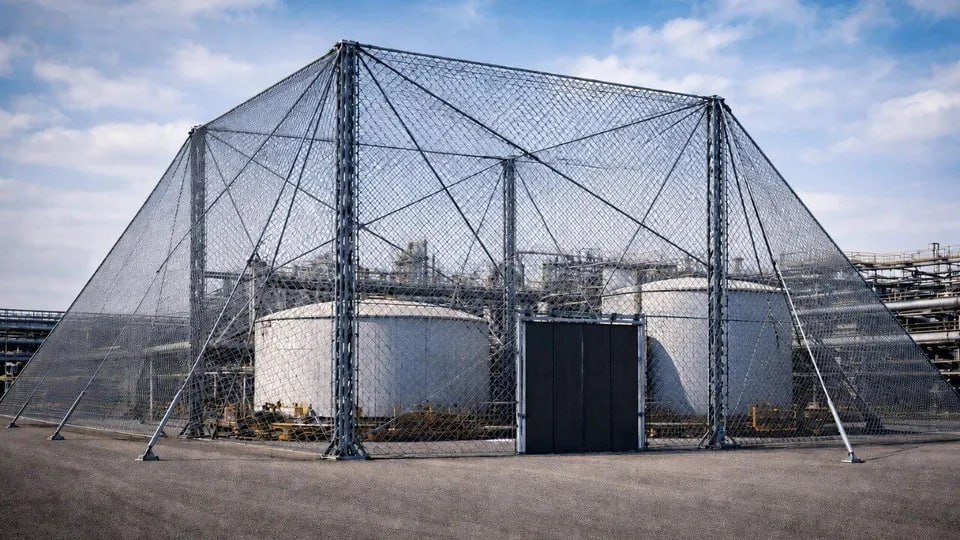
The Russian state-owned corporation «Rostec» has unveiled the «Pavutina» physical defence system for industrial facilities against drones. The system, comprising columns, supports and a high-tensile mesh, was developed by RT-Proektnye Tekhnologii and Standard Electric; it is already undergoing trial operation at several sites in the fuel and energy sector.
Briefly about the main points
- «The Web» consists of metal supports, columns and a tensioned load-bearing mesh.
- The structure is assembled using bolts, without any welding.
- «Rostec has claimed that the drone can withstand an impact from a 200-kilogramme object.
- Mesh fencing for private homes is sold by certain Russian companies.
- The manufacturer describes the system as part of a multi-layered defence system.
Modular barrier for businesses
«Pavutina» was officially unveiled on 15 July at the Drone Expo-2026 exhibition. According to the developers, the modular metal structure can be adapted to sites of virtually any size and to buildings over 25 metres high.
The system components are bolted together. This method makes it possible to install the structure, in particular, at oil storage facilities, gas sites and other premises with a high fire risk, where welding work is undesirable. It is also designed to facilitate the replacement of damaged sections.
Among the potential applications, the developers cited electric substations, warehouses, oil storage facilities and industrial plants. In Russia, a separate set of regulations for the design of protective barriers against drones has been in force since January 2025, formalising this aspect of engineering protection.
The stated strength is no substitute for other means of defence
«Rostec claims that the basic version of »Pavutina« is capable of withstanding a direct hit from a drone weighing up to 200 kilograms and travelling at a speed of 250 km/h. If necessary, they propose enhancing the level of protection without developing a new design.
This stated combination of mass and velocity corresponds to a kinetic energy of approximately 482 kJ. However, the actual result will depend on the angle and point of impact, the properties of the UAV’s airframe, the geometry of the frame, and the parameters of the net and its fixings. There are no publicly available independent test reports documenting full-scale testing of the system under these parameters.
Even if the drone is intercepted by a net, this does not eliminate the risk of a blast wave, debris or the warhead catching fire. Deputy Director-General of Rostec« Oleksandr Nazarov He also stated that «Pavutina» is intended to be used in conjunction with electronic countermeasures and kinetic defence systems. This suggests that the manufacturer regards the net as one of several layers of defence, rather than a standalone air defence system.
Experience of using mesh barriers in warfare highlights another limitation: damage to the mesh caused by the first drone can create a gap for the next one to pass through. Whilst this scenario does not put «Spiderweb» to the test, it does explain why a physical barrier cannot guarantee protection against a series of attacks.
The private market for window screens
At the same time, commercial offers have emerged in Russia for owners of private homes: companies in the Moscow region and Kazan are offering metal frames with mesh stretched over the roof or around the perimeter of the plot. In some advertisements, the starting price is around 1,300 roubles per square metre. These structures should not be confused with Rostec’s «Pavutina» complex: their effectiveness and the scale of their actual deployment have not been confirmed by independent data. The name of the complex also coincides with the name of the SBU’s «Pavutina» operation, during which, on 1 June 2025, Ukrainian FPV drones attacked strategic aircraft at Russian airfields. Rostec has not explained the choice of name, officially linking it to the principle of a «web-like» interception of drones.