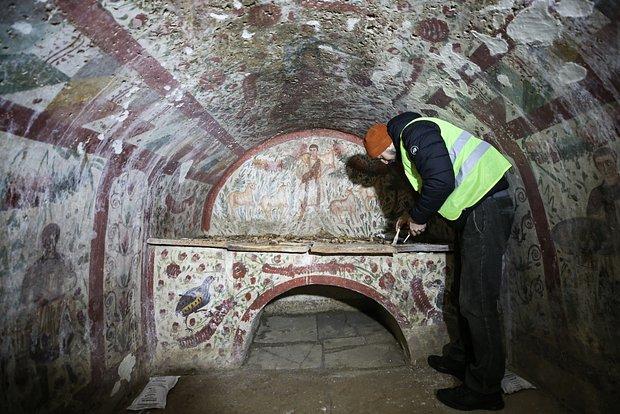
In Turkey, archaeologists have discovered a rare early Christian depiction of Jesus Christ without a beard. The fresco, dating from the 3rd century, depicts Jesus as the Good Shepherd and has been preserved in a tomb beneath the town of Iznik, formerly known as Nicaea. This artefact is of exceptional historical value, given Iznik’s role in Christian history.
- A 3rd-century fresco of Jesus without a beard has been discovered in Turkey.
- The image of Jesus is depicted as the Good Shepherd.
- The fresco was discovered in a tomb beneath the town of Iznik.
- The image dates back to early Christianity, before the adoption of the cross as a symbol.
- Iznik is famous for hosting the First Ecumenical Council in 325.
A rare depiction of Jesus Christ as the Good Shepherd
Archaeologists in Turkey have discovered a fresco dating from the 3rd century, depicting Jesus Christ without a beard. In it, Jesus is depicted as the Good Shepherd — a symbol of early Christianity, when Jesus was often portrayed as a young shepherd with a kid or a sheep on his shoulders. This image symbolised the salvation of the human soul prior to the establishment of the symbol of the cross. On this subject reports publication Oxu.
The historical context of the discovery at Iznik
The fresco was discovered in a tomb beneath the modern-day town of Iznik, which was known as Nicaea in ancient times. It was in this very town that, in the year 325, The First Ecumenical Council of the Christian Churches, at which the Nicene Creed was adopted. The discovery is of particular significance as it illustrates Christian art in the immediate run-up to important events in the history of the Church.
The uniqueness of the Roman style of fresco painting
The fresco is executed in the Roman style, which is rare in early Christian art. Its excellent state of preservation enables researchers to gain a better understanding of the artistic traditions of that period and the symbolism used to depict Jesus. The absence of a beard in the depiction is an unusual feature that sets this work apart from traditional Christian images.
The discovery of this fresco provides new insights into visual representations of Jesus Christ in the early Christian tradition. It adds to our understanding of how Christian communities conveyed their beliefs through art prior to the widespread adoption of the symbol of the cross. The find encourages further archaeological research in the region to study early Christian sites.