France and Germany have begun preparing amendments to the draft seven-year European Union budget for 2028–2034, in order to safeguard long-term funding for Ukraine against a possible block if Marine Le Pen comes to power. Paris and Berlin are proposing to incorporate specific financial and procedural safeguards into the document before the French presidential election takes place. The main challenge for European capitals remains the lack of time, as full ratification of the budget agreement requires the approval of the European Parliament and the national parliaments of all member states.
- France and Germany are preparing amendments to the EU budget for 2028–2034 to safeguard funding for Ukraine.
- Paris is calling for an additional 35 billion euros in subsidies for farmers to make it politically unviable to walk away from the deal.
- Berlin is calling for aid to Kyiv to be enshrined in EU legislation and for a switch to majority voting rather than unanimity.
- It is unlikely that the budget will be finalised by the parliaments before the April elections in France.
What precautions are Paris and Berlin putting in place?
The European Union’s two largest economies are seeking to raise the political and financial stakes in advance of any attempt to revise the bloc’s future multiannual budget following the French elections.
To this end, Paris and Berlin are promoting various, yet interlinked, mechanisms:
France’s initiative: The French government is seeking an additional 35 billion euros in agricultural subsidies for farmers as part of the 2028–2034 budget, in order to make these payments permanent and make it more difficult to revise them in the future.
Germany’s requirements: Berlin is insisting that long-term support for Ukraine be explicitly enshrined in EU budgetary legislation, and also wishes to introduce a system whereby decisions on the allocation of funds are taken by a qualified majority rather than by the principle of unanimity, which allows individual countries to impose a veto.
German Chancellor Friedrich Merz made it clear that Berlin, which funds around a quarter of the European Union’s expenditure, would not support the final budget package without such guarantees.
Marine Le Pen’s stance and Brussels’ financial calculations
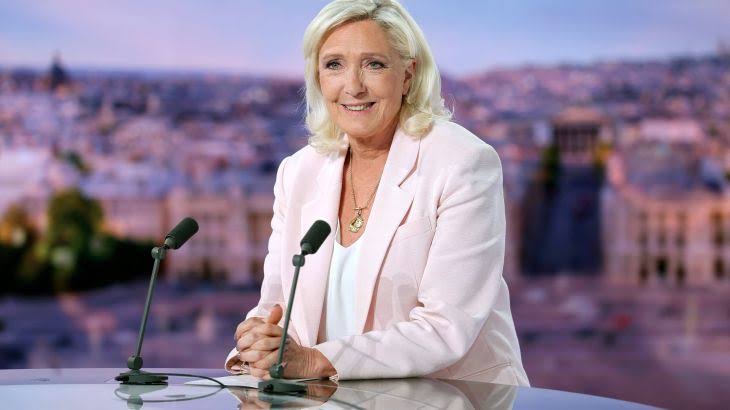
The leader of the French far right Marine Le Pen has repeatedly stated its intention to reduce France’s contributions to the EU’s common budget and to review its financial support for Kyiv. Previously, she had also spoke out against Ukraine’s accession to the European Union and had stated the need for reduction in financial assistance Kyiv, allowing only certain forms of material or humanitarian support. At the same time, the politician herself described the current government’s attempts to fast-track the budget’s adoption before the elections as an attempt to restrict voters« democratic choice, whilst her actual ability to block the agreement will also depend on the results achieved by the »National Union’ party in the parliamentary elections.
Meanwhile, discussions are continuing in Brussels regarding the total amount of funding for Ukraine for the next budgetary cycle:
The European Commission has already proposed allocating 100 billion euros over seven years, but in a number of capitals this sum is considered insufficient to meet Kyiv’s needs;
Separately, the European Union will have to resolve the issue of paying over 50 billion euros in interest on the loans taken out to support Ukraine.
The main obstacle to the Paris and Berlin plan remains the timetable: even after political agreement at the EU leaders’ summit, the budget package must be ratified by the European Parliament and the national parliaments of the Member States, so it is highly unlikely that the procedure will be completed in time for the first round of the French presidential election in April.