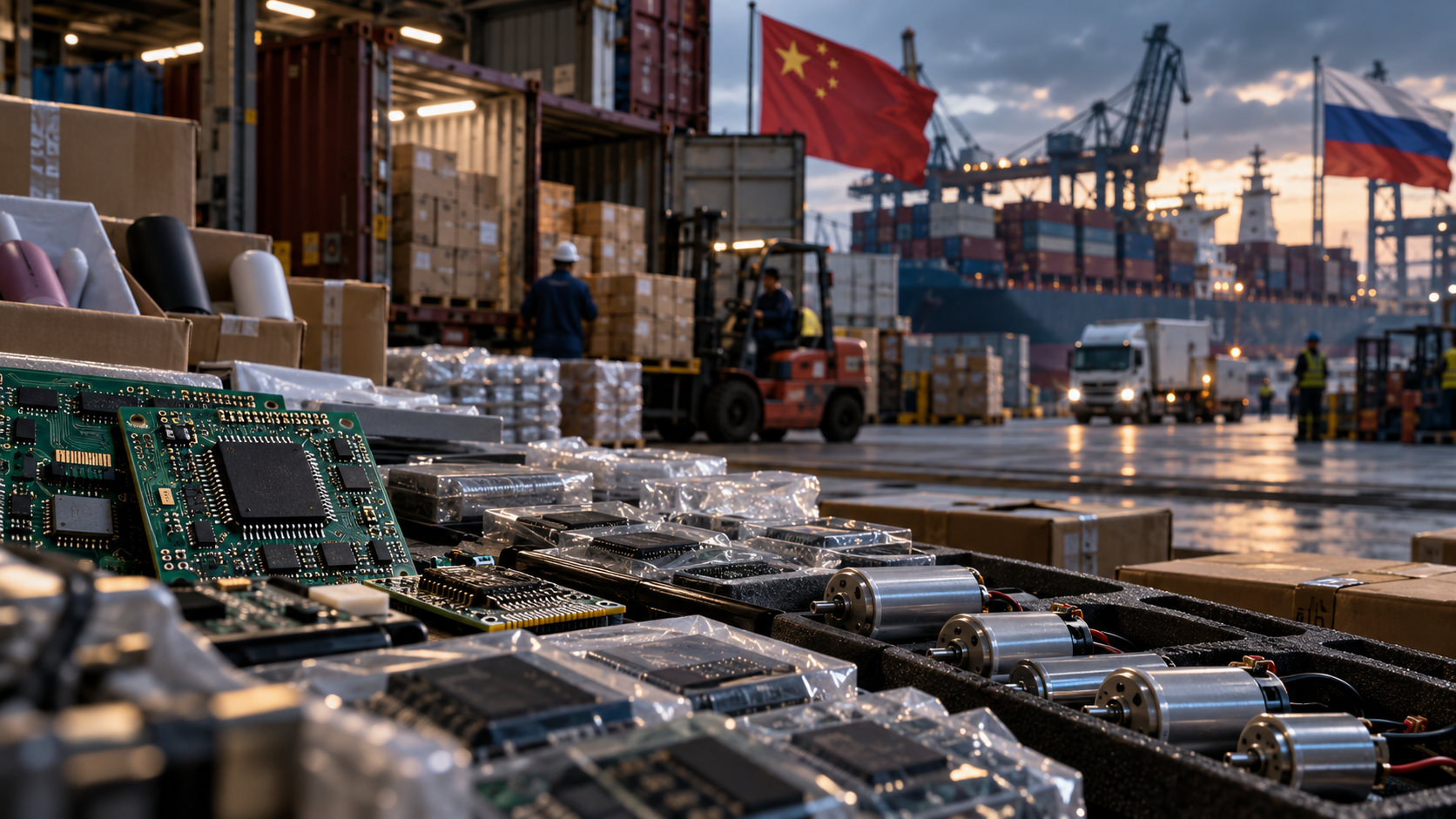
The Chinese company Shenzhen NuanQin Technology, which markets itself as a manufacturer of «smart» sex toys, has been supplying integrated circuits and electric motors to Russia that could be used in the defence industry. This was uncovered by analysts at the Independent Anti-Corruption Commission (NAKO), who examined over 180,000 customs declarations. The organisation’s executive director, Olena Tregub, reported the findings of the investigation on 8 October 2026 in a column for Forbes Ukraine. The investigation identified thousands of foreign suppliers of electronics to the Russian Federation and hundreds of addresses linked to companies subject to sanctions.
Briefly about the main points
- A Chinese sex toy manufacturer was supplying microchips to Russia.
- The goods included integrated circuits and electric motors.
- More than 8,000 foreign suppliers have been identified.
- More than 450 companies used high-risk addresses.
How a sex toy manufacturer came to be among the suppliers of electronics to Russia
One of the most unusual examples identified in the NAKO study was the company Shenzhen NuanQin Technology from the Chinese city of Shenzhen. It markets itself as a manufacturer of smart products for adults, but an analysis of customs documents has revealed that it has been supplying Russia with entirely different products.
The goods declared included integrated circuits, industrial electronic components and electric motors. Such equipment has civilian applications, although certain types may be used in drones, control systems, navigation equipment and other military hardware.
According to the study, between January 2023 and February 2025, NuanQin Technology made at least 30 deliveries to the Russian importer Legion Komplekt LLC. The total declared value of these consignments was approximately $425.9 thousand.
One of the consignments, valued at $17 214, contained 10,000 industrial-grade integrated circuits. The declared value of the electric motors in the consignments examined exceeded $176 thousand.
At the same time, the presence of electronic components The presence of such information in customs documents does not in itself prove that every consignment went directly to a Russian defence factory or breached specific sanctions. The main focus of the investigation is the lack of transparency in the supply chains for dual-use goods.
NAKO has identified over 8,000 foreign suppliers
The investigation covered a much broader market than the activities of a single Chinese company. NAKO analysts examined customs declarations relating to imports of priority microelectronics into Russia and cross-referenced information on foreign suppliers against sanctions lists and company registers.
Key findings of the study:
| Indicator. | Result |
|---|---|
| Customs declarations analysed | Over 180,000 |
| Identified foreign suppliers | Over 8,000 |
| Addresses associated with companies subject to sanctions | Over 200 |
| Suppliers who have used these addresses | Over 450 |
| Companies at one of the addresses surveyed | At least 45 |
| Of these, those subject to sanctions or export controls | 14 |
Data from a study by the Independent Anti-Corruption Commission, «Follow the Trail», September 2026.
The results show that simply checking the counterparty’s legal name may not be sufficient. A company may change its name or owner, or set up a new legal entity, whilst its office, logistics links and corporate infrastructure remain unchanged.
It is precisely these recurring addresses that enable researchers to identify potential links between companies which, at first glance, appear to have nothing in common.
Why does the Russian defence industry rely on foreign microchips?
Modern weaponry requires sophisticated electronics. Microcontrollers, processors, electric motors and other components are used in unmanned aerial vehicle control systems, communications equipment, navigation systems and industrial equipment.
Some of these products are dual-use: they can be used in both civilian equipment and military production. This is precisely what complicates export controls, as the end-use of components cannot always be determined from the product’s name or the profile of the purchasing company.
For Russia, international intermediaries remain one of the ways of obtaining foreign technologies to which access is restricted by sanctions. At the same time, the suppliers may be companies whose core business is not related to electronics at all.
The NAKO study mentions companies from the pharmaceutical sector, manufacturers of pipeline fittings and other enterprises which also featured in documents relating to the supply of microelectronics.
Proposals to tighten controls on supplies to the Russian Federation
The authors of the study propose a change in approach to sanctions screening. Instead of analysing only the company’s name, attention should be paid to its actual address, links with other legal entities, corporate history and shared infrastructure. This approach makes it possible to identify potentially high-risk counterparties even when they have not yet been included on sanctions lists.
NAKO also proposes the creation of an international list of high-risk addresses, which could be used by regulators in the US, the EU, the UK, Japan and other countries. Similar mechanisms for targeted control are already in place in the US.
However, the researchers emphasise that a shared registered address does not automatically constitute evidence of a breach of sanctions. It merely indicates the need for further investigation.
The findings of the study highlight a wider issue concerning international export controls. Even with restrictions in place on the supply of high-tech products, Russia continues to utilise extensive networks of foreign intermediaries. For sanctions to be applied more effectively, it is necessary to monitor not only individual suppliers but also the links between companies and the end recipients of the products.