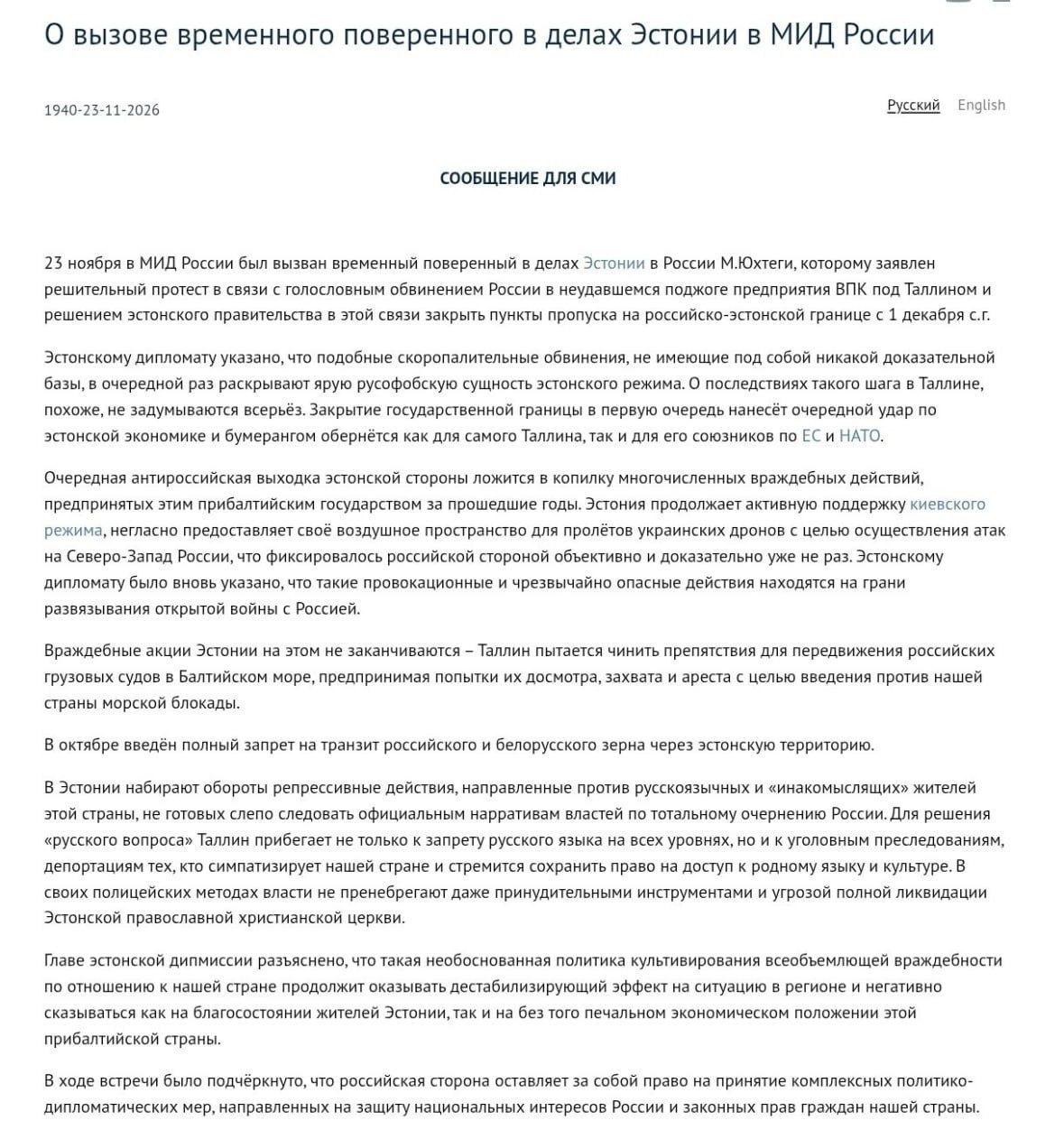
The Russian Ministry of Foreign Affairs has issued an official statement containing harsh accusations against Estonia, using rhetoric about «protecting the Russian-speaking population» and threatening «comprehensive measures». According to the Estonian broadcaster ERR, the diplomatic row arose following Tallinn’s decision to close border crossing points with Russia.
- The Russian Foreign Ministry summoned the Chargé d’Affaires of Estonia and lodged a protest over the closure of the border from 1 December.
- Moscow has accused Tallinn of repressing Russian speakers, banning the Russian language and taking actions «on the brink of open war».
- The Russian agency stated that it reserves the right to take measures to «protect national interests and the rights of citizens».
- The Estonian authorities have rejected the allegations, describing them as baseless propaganda against the backdrop of sabotage by the Russian security services.
What allegations has the Russian Foreign Ministry made?
According to a press release dated 23 November 2026, the Russian Ministry of Foreign Affairs summoned the Chargé d’Affaires of Estonia. The reason was Moscow’s protest against Tallinn’s decision to closure of the road border from 1 December and allegations that the Russian Federation was involved in an attempted arson attack on a defence industry facility near Tallinn.
Apart from allegations regarding the economic consequences and the obstruction of shipping in the Baltic Sea, the Russian ministry devoted a significant portion of its statement to the so-called «Russian question» in Estonia. In particular, Moscow claims that Tallinn allegedly:
resorts to «repressive measures» against Russian-speaking and «dissident» residents;
bans the Russian language at all levels and carries out criminal prosecutions and deportations;
threatens to dissolve the Estonian Orthodox Christian Church.
The Russian Foreign Ministry also reiterated its allegations that Estonia was allegedly providing airspace for Ukrainian drones, describing Tallinn’s actions as being «on the brink of unleashing an open war with Russia». At the end of the statement, Moscow emphasised that it reserves the right to take «comprehensive political and diplomatic measures» to protect its interests and the rights of its citizens.
What was the response from Tallinn?
The Estonian Government has rejected Moscow’s claims. The Minister for Foreign Affairs Margus Tsakhkna в comments Speaking to ERR, he stated that Russia is spreading baseless accusations in order to divert attention from its own actions, which undermine European security. Separately, the Estonian leadership has already clarified that Tallinn’s position on the attacks, objecting to the use of its airspace for strikes against the Russian Federation.
The decision to suspend operations at all five road border crossings with Russia (Narva-1, Narva-2, Koidula, Luhamaa and Saatsi) has been explained in Tallinn on the grounds of national security. According to the Estonian Internal Security Service (KAPO), Russian military intelligence (GRU) was behind the arson attempts targeting the defence companies Threod Systems and Milrem Robotics.