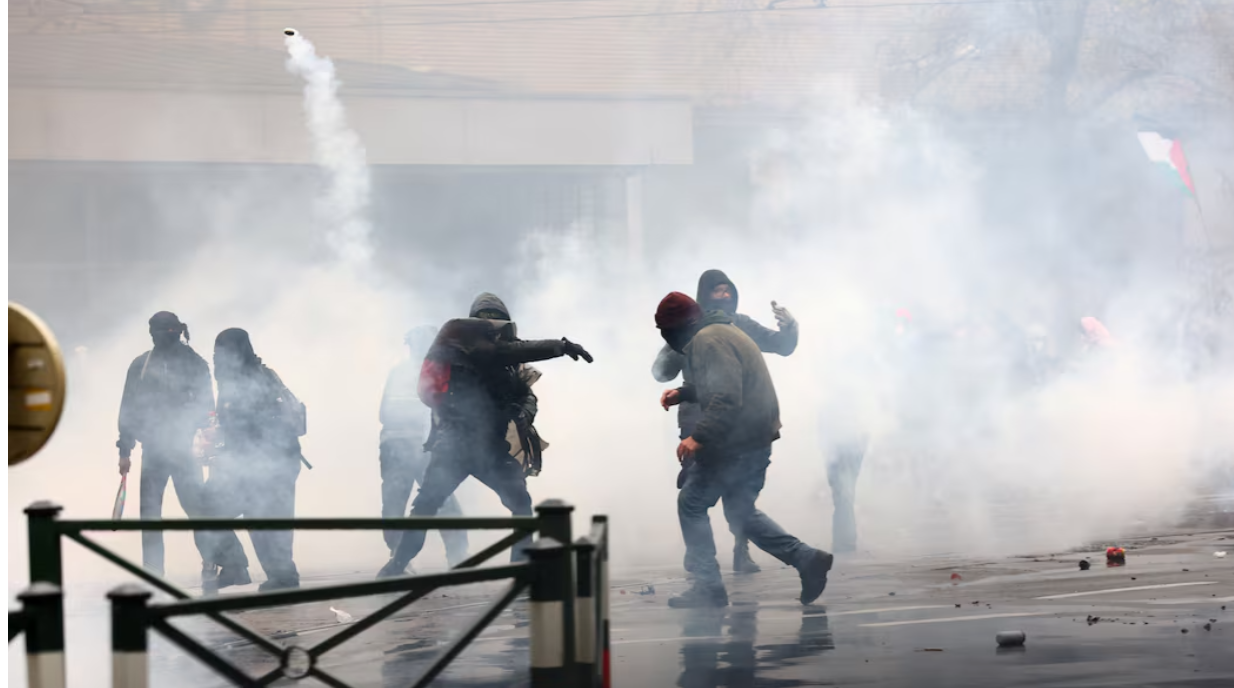
On 9 October 2026, large-scale protests against the government’s budgetary policy took place in the Belgian capital, accompanied by clashes with the police, arson and arrests. According to law enforcement estimates, around 30,000 people took to the streets of Brussels, including workers, trade union activists and students. Near the Central Station, groups of masked youths began throwing stones, bottles and fireworks at police officers. The police responded with water cannons and tear gas. A total of 21 people were arrested, including 13 minors. Against the backdrop of the nationwide strike, the city experienced disruptions to public transport, air travel and the operation of educational institutions.
Briefly about the main points
- On 9 October, around 30,000 people took part in a protest in Brussels.
- The reason is the government’s planned budget cuts.
- Clashes with the police broke out near the Central Station.
- Protesters set fire to property and threw stones.
- Twenty-one people were arrested, including 13 minors.
In Brussels, thousands of people took to the streets to protest against the government’s budgetary policy
On Friday, 9 October, Brussels became the centre of a nationwide protest organised by Belgium’s two largest trade union confederations — the socialist FGTB/ABVV and the Christian CSC/ACV. The participants protested against planned cuts to public spending and reforms which, in their view, will worsen the financial situation of workers, pensioners and low-income families.
The protest march began near the Central Station. People took to the streets carrying trade union flags, placards and chanting slogans against the government’s decisions. Hundreds of students joined the demonstration, protesting against rising tuition fees and possible restrictions on access to higher education.
According to the police, Around 30,000 people took part in the demonstration. The organisers put the figure at around 50,000 participants.
The main trade union march passed through the city peacefully. However, at the same time as the demonstration, groups of young people dressed in black and wearing masks gathered in the centre of Brussels and clashed with the police.
The police and trade union organisers emphasised that those involved in the disturbances were not connected to the main peaceful march.
Clashes with the police broke out near the Central Station
The first serious disturbances broke out near Brussels Central Station, where participants in the nationwide strike had been gathering since the morning. According to Reuters eyewitness reports, several dozen people dressed in black and wearing masks began throwing stones and other objects at the police. Anti-police graffiti appeared on the surrounding streets, and later those involved in the clashes set fire to bicycles, electric scooters and other property.
Law enforcement officers used tear gas and water cannons to disperse violent groups. Direct clashes broke out between demonstrators and police in several locations. Following the clashes, some of those involved in the disturbances attempted to blend in with the main protest march.
Tensions were also high in the central Marolles district, through which the march route passed. According to AFP, groups of young people there clashed with police units, who repeatedly used water cannons to disperse the crowd.
At the same time, the majority of demonstrators continued their peaceful march. The trade unions distanced themselves from the disturbances, stating that their aim was to draw attention to socio-economic issues, rather than to organise violent protests.
The police have arrested 21 people, including 13 minors
According to the Brussels police, 21 people were arrested during the riots. Thirteen of those arrested were minors. The police attribute the arrests to breaches of public order, attacks on police officers and damage to property.
Firefighters were at the scenes of the clashes, putting out small fires. In particular, there were reports of bicycles and electric scooters being set alight, as well as damage to vehicles. Reuters also reported fires near buses.
At present, there are no definitive official figures on the number of people injured during the clashes. Nor is it clear how many of those detained have been charged with criminal offences.
The situation was exacerbated by the large number of young people taking part in the protests. Some of the students and schoolchildren had travelled to Brussels after several days of protests in other Belgian cities, where the demonstrations had already been marred by clashes with the police.
Due to a strike in Brussels, the metro was suspended and flights were cancelled
The nationwide protest affected more than just traffic in the city centre. Some public transport staff also joined the strike, which meant that the number of available services was significantly reduced.
According to the transport operator STIB-MIVB, only two metro lines – No. 1 and No. 5 – were operating in Brussels on the morning of 9 October. A significant proportion of tram and bus routes were not running, whilst on those that remained in service, the intervals between services had increased.
The restrictions have also affected international air services. Brussels Airport has cancelled around 140 flights due to expected disruptions to ground services. The national airline, Brussels Airlines, has announced the cancellation of approximately 40% scheduled flights to and from the Belgian capital.
Trade union protests also led to disruptions in the running of some schools, childcare centres and local government services.
Why are the Belgians protesting against the government?
The main cause of the protests was the Belgian federal government’s plans to reduce the budget deficit. The Prime Minister’s Office Barta De Veever is attempting to implement large-scale cost-cutting measures against a backdrop of rising public debt and the costs of servicing it.
According to AFP, the government is aiming to achieve budget savings of around 10 billion euros by the end of the current parliamentary term in 2029. The public finance deficit exceeds 5% of GDP, which is putting increased pressure on the government as it prepares next year’s budget.
The measures under discussion include possible changes to taxation, social spending and labour legislation. Trade unions are opposed to an increase in VAT, restrictions on wage indexation and greater flexibility in working hours at the expense of employees.
Trade union representatives believe that the main financial burden of the proposed reforms could fall on ordinary households. Instead, they propose taxing high incomes, capital gains and the profits of large corporations more heavily.
Prime Minister Bart De Wever defends the need for budgetary savings. He stresses that without tough financial decisions, Belgium risks facing a further rise in debt and interest payments, which will place a burden on future generations.
It is expected that the government will attempt to agree on the key parameters of the budget by 13 October.
Students are calling for affordable education and protesting against cuts
A key factor behind the protests has been young people’s dissatisfaction with changes to the education system. Students and school pupils are protesting against rising tuition fees, overcrowded classrooms and insufficient funding for educational institutions.
The situation is particularly acute in the French-speaking part of Belgium, where an increase in tuition fees at higher education institutions is under discussion. Critics of the reform warn that this could make it more difficult for young people from low-income families to access higher education.
Schoolchildren’s protests had previously spread to Liège. There, the demonstrations were accompanied by damage to shops, clashes with the police and mass arrests. According to the Associated Press, more than 200 people were arrested in the city over the course of the week, and dozens of police officers were injured during the riots.
On 9 October, some members of the youth movement took part in a nationwide protest in Brussels. At the demonstration, placards could be seen calling for the right to education and opposing budget cuts.
At the same time, the demands of students and trade unions do not entirely coincide: the former focus primarily on the accessibility of education, whilst the latter oppose a broader package of economic reforms.
Trade unions have threatened to hold another general strike in November
The protest on 9 October could mark the start of a new phase of trade union action in Belgium.
Following the demonstration, the FGTB trade union reported that, according to its estimates, 50,000 people had taken to the streets of Brussels. The organisation described the protest as a warning to the government ahead of the budget vote.
The trade union has stated that, should there be an increase in VAT, restrictions on wage indexation or the introduction of controversial changes to working hours, it is prepared to organise a week-long general strike, starting on 23 November.
That said, the decision on whether to organise a new protest will depend on the government’s next steps and the outcome of negotiations with the social partners.
The current protests are taking place against the backdrop of a wider wave of social discontent across European countries. In France, students are protesting against problems with education funding; youth demonstrations are also taking place in Italy; and in Spain, tens of thousands of people have protested over the housing crisis. At the same time, these movements have different causes and are not part of a single organised campaign.
For Belgium, the key issue in the coming days will be whether the government can agree on budgetary decisions without further escalating the standoff with trade unions and student organisations.