Russians' faith in the country's right course has fallen to a critical 10.5%. The USP poll recorded a sharp drop in trust in Vladimir Putin and the government amid economic problems, internet restrictions and large-scale fires in 2026.
Sociology in Russia: trust in the government is falling sharply
A survey by the Ukrainian Sociological Portal (USP), conducted in May 2026, showed that only 10.5% of Russians believe that the country is heading in the right direction. This is a sharp drop from 36.2% in October 2025. At the same time, 81.7% of respondents assessed developments in Russia as «rather wrong» or «completely wrong».
The level of trust in the official messages of the Russian authorities remains critically low: 59.2% of respondents said they did not trust government information about the situation in the country. Only 23.2% declare full or partial trust.
Attitudes towards Putin and factors of distrust
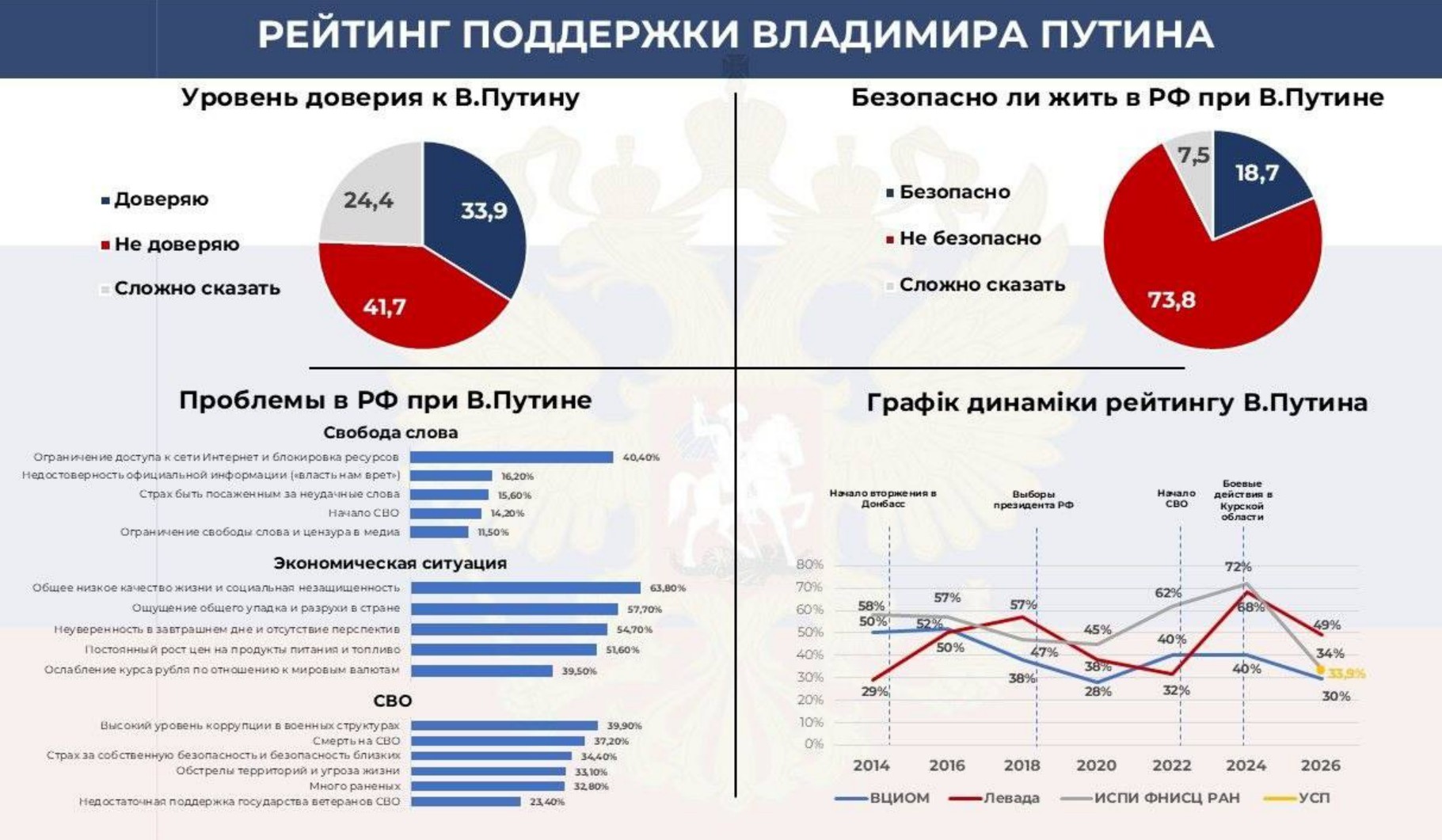
Attitude to Vladimir Putin divided: 33.81 per cent of respondents fully or partially approve of his performance, while 45.81 per cent disapprove. Another 20.4% were undecided, indicating a high level of fear of openly expressing a political position in the country.
More than half of the respondents (51.4%) named blocking Telegram and limitations mobile internet the main factors that influenced their attitude towards the President. 45.2% attributed the change in attitude to rising prices and inflation, and 31.2% to attacks by Ukrainian drones and missiles on targets in Russia.
Social atmosphere and security
The poll showed that 64.7% of Russians believe that it is better to avoid speaking out against the authorities, reflecting an atmosphere of fear and self-censorship. Only 17.5% disagree with this statement.
Security in the country is also a serious concern: 73.8% of respondents believe that living in Russia has become dangerous. Only 18.7% feel safe.
Responsibility for fires and assessment of the authorities' actions
For the large-scale fires of 2026, in particular in Tuapse, 84% of respondents hold Vladimir Putin primarily responsible. More than half (56.51 per cent) assessed the government's actions in responding to emergencies as ineffective or incompetent. Only 14.2% assessed the government's actions positively.
In addition to Putin, a significant number of respondents also pointed to the responsibility of the relevant ministries, the Russian Emergencies Ministry, supervisory bodies and the government as a whole.
Military and economic contexts
In the context of the war, Russians most often mention the high level of corruption in military structures (39.9%) and casualties in a «special military operation» (37.2%). Fear for their own safety and the safety of their loved ones is felt by 34.4%, and 33.1% speak of shelling of Russian territory.
Economic problems remain key: 63.8% link distrust of the government to low quality of life and social insecurity, 57.7% to a sense of the country's general decline, and 54.7% to uncertainty about the future.
Results and public sentiment
The results of the study demonstrate the accumulation of irritation and fear in Russian society against the backdrop of economic difficulties, restrictions on freedoms and repressive practices. A significant proportion of the population avoids open political expression, indicating a high level of self-censorship and fear of reprisals.
The research methodology included a classical telephone survey (CATI) among 2000 respondents, representative of age, gender, type of settlement and regions of the Russian Federation. The theoretical margin of error is 2.2%.