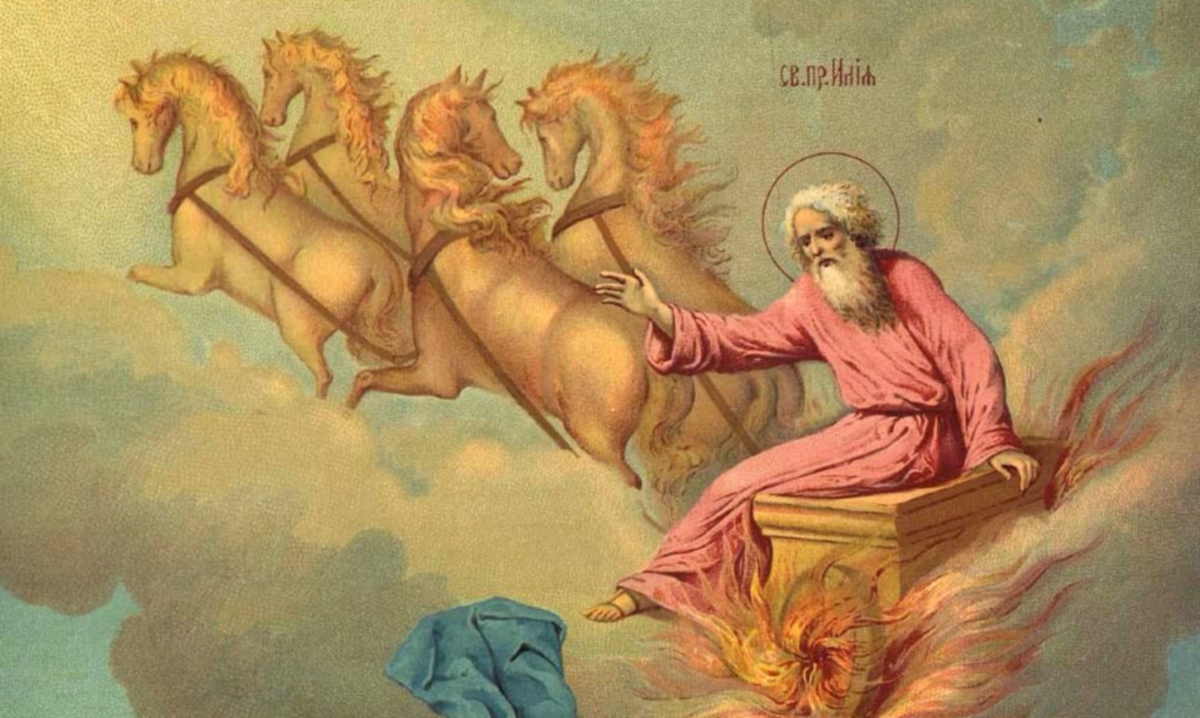
The Feast of Saint Elijah the Prophet is one of the most important, oldest and most colourful religious festivals of the summer cycle in Ukraine. In the popular imagination, the image of the Old Testament prophet has become closely intertwined with pre-Christian beliefs, which is why Elijah is regarded as the lord of thunder and lightning and the patron saint of the harvest.
Here’s everything you need to know about celebration Ilya: when we celebrate it nowadays, what its history is, what is strictly forbidden to do, and what signs can be used to predict the weather.
When is St Ilya’s Day celebrated in Ukraine?
Following the switch by the Orthodox Church of Ukraine (OCU) and the Ukrainian Greek Catholic Church (UGCC) to the New Julian calendar, the dates of most religious holidays have been moved back by 13 days.
New date: Now. Ilya In Ukraine, they celebrate 20 July. (Previously, according to the old calendar, it was celebrated on 2 August).
The origins of the festival: who was the prophet Elijah?
Ilya — one of the most famous Old Testament prophets, who lived in the 9th century BC in Ancient Israel. He went down in history as a zealous defender of the purity of the faith and a stern critic of paganism. According to legend, Elijah performed incredible miracles: he called down fire from heaven, ended a three-year drought through prayer, and once again brought rain to the earth.
It is believed that Elijah did not die a natural death, but was taken up to heaven alive in a fiery chariot drawn by a team of four horses. It is this image that gave rise to the popular belief that when thunder rumbles, it is Elijah travelling through the heavens in his chariot and hurling bolts of lightning at evil spirits.
Folk traditions for the Feast of St Elijah
In ancient times, this day was regarded as the dividing line between summer and autumn. Our ancestors used to say: «Ilya marks the end of summer», or «Before St Ilya’s Day, a man goes for a swim; after St Ilya’s Day, he says goodbye to the river».
-
A visit to the church. Believers always attend the festive liturgy. In churches, people pray for peace, good health, a bountiful harvest and rain during times of drought.
-
The blessing of seeds and bread. The harvest usually came to an end during this period. On St Ilya’s Day, the first bread made from the new harvest’s flour was baked and distributed to the whole family and to those in need.
-
Brothers. In some regions of Ukraine, there was a tradition of organising communal meals for the whole village — they would bake bread, brew ceremonial beer and treat the poor.
What should you not do on St Ilya’s Day?
There are a number of strict folk and religious prohibitions associated with this day:
-
Swimming in bodies of water is strictly prohibited. This is the main taboo. Our ancestors believed that from this day onwards the water turns cold («Ilya peed into the water» or «dropped an ice cube in»), and that evil spirits (water sprites and mermaids) become active at the bottom of the water, capable of dragging people into a whirlpool.
-
You cannot work in the fields or in the vegetable garden. Ilya is regarded as an irascible saint. It was believed that if people worked on this day, he might punish them with fire by striking a haystack with lightning, or destroy their crops with hail.
-
Livestock must not be let out to pasture. It was believed that on this day, wild animals and reptiles were more active than usual, and that evil spirits, hiding from Elijah’s thunder, might take possession of domestic animals.
-
You must not use bad language or argue. As with any major holiday, it is important to keep your thoughts and speech pure.
What can be done?
-
To gather medicinal herbs and rainwater (which was believed to have healing properties).
-
To look after the bees and the apiary (Ilya is considered one of the patron saints of beekeeping).
-
To invite guests, organise family meals and show kindness.
Folk traditions on St Ilya’s Day
Our ancestors kept a close eye on the weather on this day in order to predict what autumn and winter would be like:
| Superstition | What does it mean? |
| Muffled thunder on Ilya’s Day | Light and gentle rain is expected. |
| Ringing or continuous thunder | There will be a heavy downpour with hail. |
| Clear and sunny weather | Autumn will be long, dry and warm. |
| Rain on St Ilya’s Day | The grain harvest will be bountiful, and there will be few fires this year. |
| After St Ilya’s Day, the mosquitoes and flies go to sleep | A sign that autumn is just around the corner. |