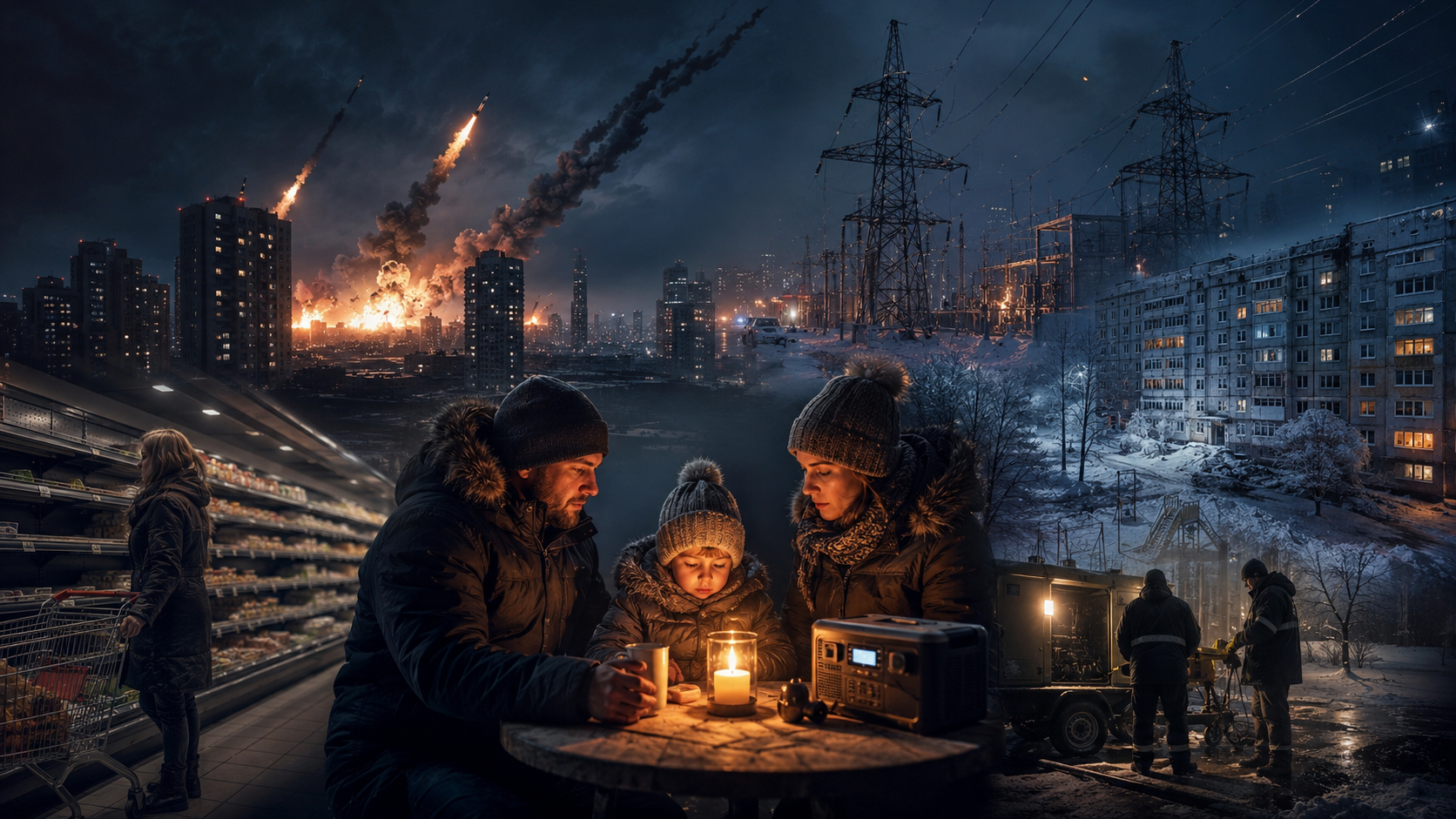
Kyiv and the Kyiv region are preparing for the 2026/27 heating season at a time when Russia is simultaneously stepping up its attacks on the energy sector, gas infrastructure and logistics. An analysis of the latest attacks, assessments by the Main Intelligence Directorate, the state of reserve power generation, preparations within the heating sector and the situation regarding food warehouses indicates that the baseline scenario does not foresee a complete, prolonged collapse of the capital; however, localised blackouts, heating problems in certain districts and shortages of some food items this autumn and winter are entirely realistic.
This article — an analytical forecast generated by AI based on open data as at 20 August 2026. This is not an official forecast from the government: the situation will depend primarily on the intensity of Russian strikes, the Russian Federation’s stockpile of missiles, the number of Ukrainian interceptors and the speed at which damaged infrastructure is repaired.
Briefly about the main points
- In winter, there may be prolonged power cuts following attacks by the Russian Federation.
- Local heating problems remain a real risk.
- No food shortages are expected, but there may be some disruptions to supplies.
Why the winter of 2026/27 might be more challenging
Recent events show a change in the nature of Russian attacks. On the night of 20 August, the Russian Federation carried out a prolonged a combined attack on Kyiv and the surrounding region using ballistic and cruise missiles, as well as a large number of drones. Following the attack, part of the capital was left without electricity: DTEK reported that, using backup systems, power had been restored to around 50,000 households, whilst around 40,000 homes remained without power at that time.
Namely. ballistics is one of the main concerns for the coming winter. Analysts at Critical Threats/ISW, citing Ukrainian data, wrote that Russia may launch a new campaign against the energy sector earlier than last year, seeking to exploit Ukraine’s shortage of anti-missile interceptors. In August, there were already reports of preparations for a large-scale campaign against Kyiv’s energy infrastructure.
At the same time, the deputy head of the Main Intelligence Directorate Vadym Skibitskyi He warned outright that, in the autumn and winter, Russian targets would remain electricity, gas and water infrastructure. According to intelligence reports, the Russian Federation has even developed a specialised a drone designed to damage metal pylons electricity networks.
This marks a significant change: the enemy may attempt to target not only large thermal power stations and substations, but also the more numerous components of the distribution network.
Electricity forecast: there will be power, but stability is not guaranteed
For Kyiv, the most likely scenario appears to be alternation between normal system operation and periods of emergency or planned restrictions following attacks.
It is now much more difficult to cut off power to the metropolis for an extended period than it was in the early years of the war. Kyiv has built up a large stockpile of autonomous equipment. In early 2026, the city reported approximately 1,120 generators for critical, medical and social infrastructure, as well as thousands of units of backup equipment for residential buildings.
Distributed generation is also being developed. As of May, around 40 MW of combined heat and power capacity, whilst four units with a combined capacity of 18 MW were installed at one of the critical facilities.
The Kyiv region has also become significantly less dependent on one or two major sources. In the region in May it was reported already about 84 combined heat and power plants with a total capacity of 195.65 MW, of which approximately 50 MW have been commissioned since the start of the year. In addition, over 300 MW of solar generation is in operation.
Whilst this cannot fully replace the capital’s and the region’s main power grid, it does alter the nature of any potential blackout.
My baseline forecast: If Russia continues its attacks at the current intensity, the most common scenario will be power cuts lasting several hours, followed by a gradual restoration of supply via backup circuits. Following a strike that is particularly successful for the Russian Federation, certain areas may remain without electricity for longer — ranging from a significant part of a day to several days — if the damage affects complex high-voltage equipment.
A total blackout in Kyiv lasting several days in a row is only possible in a worst-case scenario — following a series of successful strikes on several key infrastructure sites simultaneously.
The biggest problem is ballistics and the shortage of interceptors
The Ukrainian energy sector has learnt to recover fairly quickly from drone and some missile strikes. Weapons that are difficult to intercept remain a problem.
President Volodymyr Zelenskyy following the attack on 20 August, he reiterated that interceptor missiles for the Patriot system At present, there is effectively nothing that can fully replace it.
Critical Threats previously noted that Russia is likely seeking to exploit the shortage of anti-ballistic interceptors and may be directing ballistic missiles at energy infrastructure in Kyiv.
Therefore, the key variable in the forecast is not even the number of Russian Shaheds. The decisive factor may be the ratio:
Russian ballistic missiles ↔ Ukrainian Patriot missiles and PAC-3 stocks.
If Ukraine receives a sufficient number of interceptors, the winter scenario will improve significantly. If supplies remain limited, Russia will be able to launch more costly but more precise strikes against critical infrastructure.
Heating: the risk of localised incidents is higher than the risk of the whole of Kyiv freezing over
The capital’s heating system remains one of the most difficult to protect, as it depends simultaneously on heat generation, gas, electricity and pumping equipment.
Klitschko 17 August, live said., that Kyiv is preparing for «a very difficult heating season». At that point, around half of the planned work had been completed, and he identified the creation of a backup system as one of the key tasks.
The town already has 69 mobile boiler houses, which can be used for hospitals, social care facilities and individual housing estates in the event of damage to the main heat sources.
In the Kyiv region, the government has allocated funds for 216 modular boiler houses, intended to provide emergency accommodation for households and social care facilities.
Work is also continuing in Kyiv on the construction of a gas-fired combined heat and power plant, which generates both electricity and heat. It is precisely this kind of decentralisation that makes the system less vulnerable to the destruction of a single large facility.
But there is a weak point here: gas.
Russia is stepping up its attacks on the gas network
Naftogaz reports a sharp increase in Russian attacks. As of 7 August, the group’s facilities have come under attack since the beginning of 2026 287 attacks — more than in the whole of 2025 and the first three years of the full-scale war combined.
The company is already seeking international funding for additional gas imports, backup equipment and the restoration of damaged facilities. Ukraine is also increasing its diversified imports, including US LNG via European infrastructure.
This leads to an important conclusion.
The main risk for Kyiv this winter is not so much the physical lack of gas in the country as damage to specific heat sources, the power supply to pumping stations or local heating networks.
It is therefore possible that, whilst one area has electricity, a few houses or a neighbourhood may be temporarily without heating.
Such incidents are particularly dangerous during severe frosts: following a prolonged power cut, there is a risk of damage to the building’s internal systems.
What will happen to the food?
The situation here is fundamentally different.
I do not currently foresee any physical food shortages in Kyiv.
Ukraine remains a major food producer, and Kyiv receives goods from dozens of regions via numerous independent logistics operators.
However, Russia has already demonstrated its ability to create local shortages on the shelves, destroying large distribution centres.
Following the attacks on 5 August, supply problems arose at «Silpo» and «Handicaps»: companies had warned that deliveries of some products would take longer. Some shops did indeed have empty shelves.
Cold-chain logistics was the hardest hit. According to published estimates, the attacks rendered approximately 80,000–100,000 square metres of cold-storage space Kyiv and the surrounding region. This particularly affects meat, dairy products, fish, vegetables and fruit.
By mid-August, retail chains had already begun to restock their product ranges, whilst Silpo planned to have supplies largely back to normal by 24 August.
New strikes on warehouses are once again setting logistics back.
What might actually be in short supply in shops
If the campaign against warehouses continues, it will not be cereals or tinned food that are most at risk.
First and foremost, the following may temporarily disappear:
chilled meat, fish, dairy products, eggs, some fruit and vegetables, ready meals and products with a short shelf life.
The reason is simple: it is more difficult for them to set up an alternative supply chain quickly.
Dry goods, water, cereals, pasta, tinned food and most groceries are much easier to redirect via other warehouses.
Therefore, the scenario that «there is no food in Kyiv» seems unlikely. Instead, the scenario is:
«In a particular chain, a certain brand of milk, meat or vegetables is out of stock for two or three days»
— has already taken place this August and may happen again.
Will prices rise?
The risk is higher here.
When the warehouse is destroyed, the network pays for:
- the transport of goods from more remote regions;
- the letting of new premises;
- additional refrigeration capacity;
- insurance and safety;
- lost goods;
- back-up generators and fuel.
Some of these costs are eventually passed on in the final price.
In August, experts were predicting potential price rises for certain categories of goods by 5–20%, but this is a scenario-based estimate, not a guaranteed overall rise in prices.
I would expect prices not to rise across the board all at once, but rather in a more uneven manner: goods requiring cold-chain logistics are most at risk.
Three scenarios for Kyiv and the surrounding region
The baseline scenario — the most likely one
Russia continues to launch combined strikes, but Ukraine is intercepting most of the missiles and drones.
Light: occasional emergency and hourly power cuts, lasting from a few hours to part of a day following severe cyber-attacks.
Heat: Most of the city is heated consistently, but localised outages lasting a few hours or several days are possible.
Products: There is no general shortage, but following attacks on warehouses, some retail chains are experiencing problems sourcing fresh produce.
This scenario currently seems the most realistic.
A negative scenario
Russia regularly launches large salvos of ballistic missiles at the Kyiv energy infrastructure, whilst Patriot stocks are limited.
Light: Daily power cuts lasting several hours, sometimes for 12–24 hours in the worst-affected areas.
Heat: In some areas, power cuts lasting several days are possible following damage to combined heat and power stations, boiler houses or the power supply to pumps.
Products: The range of fresh produce is shrinking significantly, logistics costs are rising, and there are regular local supply disruptions.
It’s already a harsh winter, but it’s not a humanitarian crisis.
A worst-case scenario
For this to happen, Russia would need to achieve several objectives simultaneously: to cause serious damage to power generation facilities, key substations, the gas network and the heating infrastructure during a severe cold snap, whilst Ukraine must, at that moment, have a critically insufficient number of interceptors.
In that case, the following are possible multi-day power cuts in certain parts of the capital and the evacuation of residents from homes where heating cannot be restored quickly.
Such a scenario cannot be ruled out, but it is not the most likely one. Kyiv and the surrounding region now have significantly more backup power generation and alternative heat sources than they did a few years ago.
Why a total collapse is still unlikely
There are several factors that significantly enhance the region’s resilience.
Firstly, the system has become more decentralised. It is much more difficult to take dozens of combined heat and power plants out of operation at the same time than it is to take a single large power station out of operation.
Secondly, a large fleet of generators and mobile boiler units has been built up.
Thirdly, energy sector professionals have four years’ experience of restoring the system following large-scale attacks.
Fourthly, the retail sector is capable of quickly redirecting stock flows between warehouses. The fact that, following the massive losses on 5 August, some chains had already begun to restock their product ranges within a week and a half is a good practical indicator of their adaptability.
But at the same time, Russia is also adapting.
That is precisely why the winter of 2026/27 will be a struggle not just missiles versus air defence systems, but the speed of destruction versus the speed of recovery.
What Kyiv residents should have ready before the cold weather sets in
Without panic buying, I reckon I’d be able to get by 2–3 days of battery life.
The most practical kit consists of a supply of drinking water, simple food items that do not need to be refrigerated or cooked, fully charged power banks, torches, a first-aid kit and a backup power source for communication.
For high-rise buildings, it is not even a private generator that is most important, but backup power supply water pumps, heating systems, heat distribution units and lifts. Kyiv has already offered housing estates programmes to provide alternative power sources specifically for their building services.
This could have a much greater impact than dozens of small generators in flats.
AI forecast: what will winter be like in Kyiv?
Based on current strike statistics, Russia’s preparations, the state of Ukraine’s air defence, and the pace at which reserve capabilities are being built up, I I do not expect a continuous blackout lasting several months or a widespread food shortage in Kyiv and the surrounding region.
But even the prospect of a mild winter now seems unlikely.
The most realistic picture is — a mixed winter:
periods of normal operation → a massive attack → localised incidents → several hours or days of recovery → a return to normal → a new attack.
As far as electricity is concerned, I would rate the risk as tall, for localised heating disruptions — medium-high, for systemic food shortages — low, and in the event of a temporary shortage of certain categories of products — average.
The critical month may not be November, but rather the period of severe frosts in January–February: this is when electricity consumption, the strain on the heating and gas networks, and the cost of each damaged energy facility all rise simultaneously.
The biggest unknown factor is — the number of Patriot interceptors Ukraine will have by winter. It is this factor that will largely determine whether Russian ballistic strikes remain dangerously effective, or whether a significant proportion of them can be intercepted whilst still in the air.