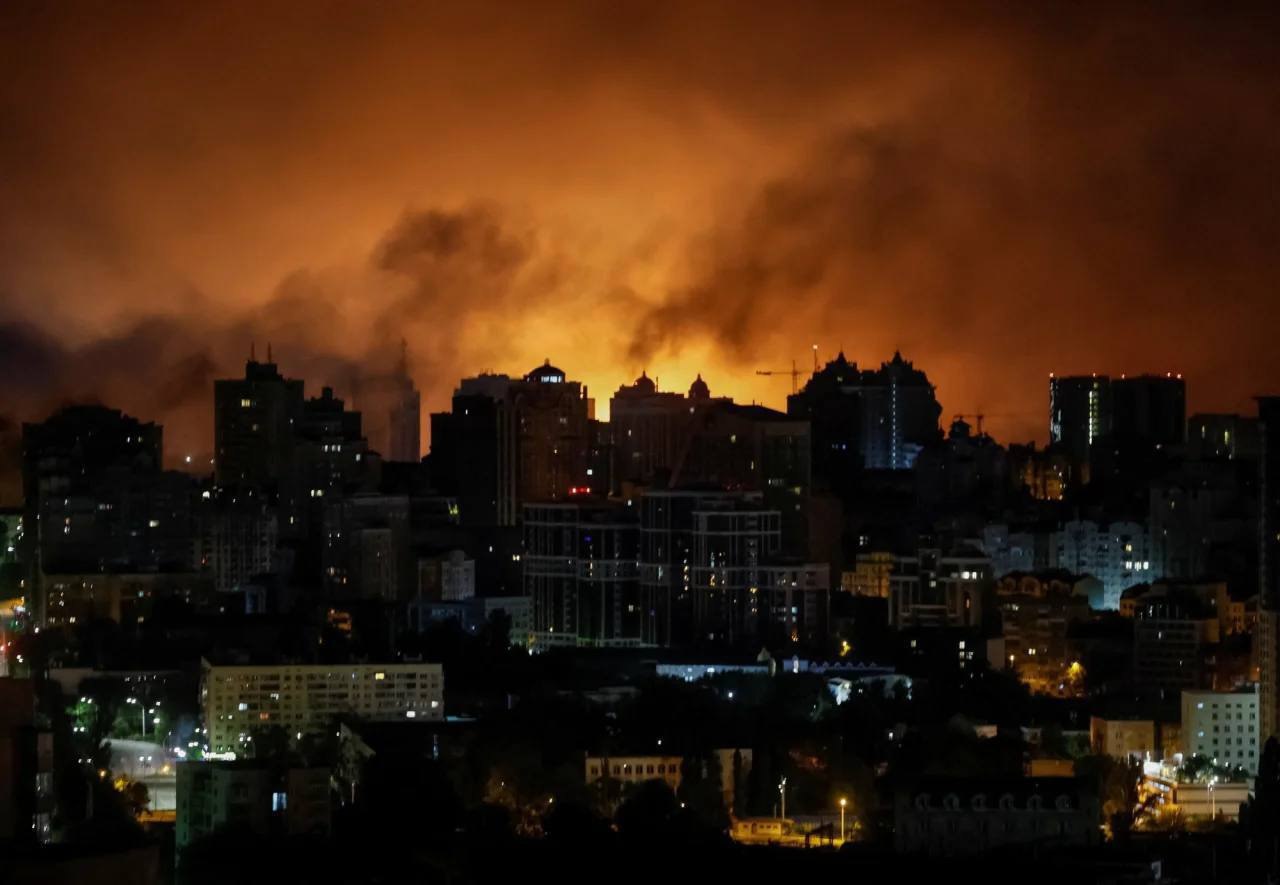
September 2026 brought about a permanent change to the rhythm of life in Kyiv. Russian missiles and drones are striking the capital in waves — at night, in the morning and in the middle of the day. Residential buildings, hospitals, transport, warehouses, businesses, data centres and internet hubs are all under attack. Air raid sirens, suspended transport services, working from shelters, backup servers and emergency logistics have become part of everyday life in this city of three million people.
Briefly about the main points
- In September, attacks on Kyiv have been taking place almost non-stop.
- Homes, hospitals, transport and businesses have been damaged.
- Attacks on data centres caused widespread internet disruptions.
- Businesses are losing production facilities, warehouses and logistics infrastructure.
- Air raid alarms are increasingly setting the pace of life in the capital.
The air-raid siren has become part of the town’s daily routine
September began for the capital with virtually no respite between attacks. As early as 2 September, there was The seventh consecutive day of Russian strikes on Kyiv. The unrest disrupted public transport, schooling and the capital’s normal working day.
The statistics themselves speak for themselves. In the week ending 4 September, there were 68 air raid alerts lasting a total of over 70 hours. On 1 September alone, the air-raid siren was sounded seven times. The following week saw a further 29 air-raid alerts. In total, the people of Kyiv spent more than 55 hours.
On 20 September, an air-raid alert was declared in the capital 10 times in a single day. Debris from the drones fell near residential buildings and in one of the parks in the Holosiivskyi district.
These are no longer isolated night-time attacks, after which the city returns to its normal routine. In September, the air threat began to dictate Kyiv’s daily routine.
1 September: the month began with eight deaths
The first day of autumn turned out to be one of the most tragic. As a result of Russian attack Eight people died on 1 September. In the Darnytskyi district, a rocket struck a non-residential building, killing seven people. Another person was killed in the Holosiivskyi district. Children were among the casualties.
Over the past 24 hours, 13 people injured in the attacks sought treatment from medical staff in the capital; three of them were residents of the suburbs. Nine people remained in hospital.
The attacks continued the following day. Ukrmedia reported damage to residential areas and a university, where classes were in progress at the time of the strike. Air raid alerts also disrupted the capital’s transport system.
8 September: over 50 sites damaged in a single attack
Another turning point was 8 September.
Following the combined attack, the following figures were recorded in Kyiv: more than fifty damaged properties. These include residential buildings, a hall of residence, school grounds, shops, petrol stations and a flour mill.
The attacks continued throughout the night and into the day. According to the city’s final figures, Five people were killed and a further 23 were injured. Warehouses were on fire in five districts of the capital at once. On that day, it was particularly clear to see how the attack paralysed not just a single building, but a significant part of the city.
Buses and trams changed their routes or suspended services temporarily. During heavy shelling At stations on the Kyiv Metro, approximately 30,000 people, including more than 2,500 children.
At the same time, Kyiv was putting out fires, rescuing people, closing roads, rerouting public transport and accommodating tens of thousands of residents in shelters.
Russian attacks have begun to target the very functioning of the city
In September, damage was increasingly occurring well beyond the confines of residential buildings.
On 17 September, she was injured in an attack 21 people, including two children. Residential, administrative and warehouse buildings were damaged. Following the night-time shelling, water pressure in the water supply system also dropped in several districts of Kyiv.
This scenario plays out time and time again: an attack on one or more targets sets off a whole chain of consequences.
Road closures are disrupting public transport routes. Damage to networks is affecting communications. Fires are affecting air quality. The destruction of warehouses is disrupting logistics and business. The war is increasingly taking its toll on urban infrastructure.
23 September: transport, shops, petrol stations and offices under attack
Kyiv has weathered another large-scale attack 23 September.
In the Darnytsia district, a transport infrastructure facility was hit and the following was recorded: fire at a petrol station. In other parts of the capital, non-residential buildings and other civilian facilities were damaged.
As of 13:00, the city authorities reported that two dead and 22 injured. Sixteen injured people were being treated in Kyiv hospitals.
However, one of the most significant consequences of this attack for the whole city was the damage to the telecommunications infrastructure.
100,000 households were affected by the disruption to data centres
On 23 September, several internet service providers reported the problems at the same time.
У «Pavutini» and UTELS were damaged data centres. Problems arose at Crazy Network following an outage at the Kyiv internet exchange point, with users feeling the effects not only in the capital.
According to information from the Ministry of Digital Transformation, as reported by Forbes Ukraine, problems with fixed-line internet in Kyiv and the surrounding region have affected approximately 100,000 households.
The next attack only made matters worse.
On 24 September, it emerged that a Russian strike destroyed a Ukrainian data centre that housed MiroHost’s infrastructure. The company’s founder Oleksandr Olshanskyi stated that there is as yet no timetable for the restoration of the Ukrainian platform.
At Cityhost, in one of Kyiv’s data centres, there was some of the equipment was destroyed. The team began restoring services in emergency mode using backups hosted on overseas infrastructure.
Provider Etherlink reported damage to a key component. The company decided to relocate the network core to another site.
An attack on a building could now mean more than just physical destruction at a specific location in Kyiv. It could simultaneously leave tens of thousands of people and companies without access to websites, servers and the internet.
Businesses are losing production facilities, warehouses and equipment
The way businesses in Kyiv operate is also changing in the face of constant attacks.
On 24 September, a Ukrainian jewellery brand Dukachi reported on the complete destruction of its production as a result of a Russian missile strike. No staff were injured, but the company has warned of possible delays in dispatching orders.
On the same day «Nova Poshta» reported on destruction of the branch No. 6 and damage to the sorting depot in Kyiv. Some of the cargo was lost. The undamaged parcels began to be transported to another location, and the company brought in backup logistics.
And this clearly illustrates the economic aspect of the attacks:
- A destroyed business is not just a building. It is machinery and equipment, jobs, unfinished orders, stock, the rent for alternative premises, and months of recovery.
- A damaged logistics centre means thousands of parcels are already on the move.
- A server failure means that websites and business systems are out of action.
- Every strike creates a ripple of consequences far beyond the point of impact.
Debris from the rocket fell near the maternity hospital
On the night of 24 September Kyiv has once again come under a combined attack.
In the Podilskyi district, rocket debris fell near Kyiv City Maternity Hospital No. 2. The windows and part of the façade of the medical facility were damaged. Patients and staff were taking cover at the time of the attack, so none of them were injured.
A person was killed in the car park next to a medical facility. A nearby clinical and diagnostic centre was also damaged. In total, the city authorities reported two fatalities and a number of casualties as a result of the overnight strike.
During the same attack, due to an air threat temporarily suspended the Kyiv Circular Commuter Train service, and as a result of the impacts, services on some buses and trams were suspended.
In the space of a single night, the war simultaneously affected hospitals, motorways, railways, public transport, data centres and private businesses.
Kyiv is increasingly operating on a backup system basis
The main change in September is not even the number of damaged buildings. What has changed is the architecture of everyday life in the capital.
An internet service provider needs a backup node. A web hosting provider needs backup servers abroad. A logistics company needs an alternative sorting centre. A business needs the ability to relocate production quickly. Public transport needs an alternative route. Hospitals need shelters where they can continue to operate during a missile attack.
On 8 September, tens of thousands of people were taking shelter in the underground at the same time. A few days later, new attacks damaged warehouses and residential buildings. On 20 September, the air-raid siren sounded ten times. On 23–24 September, strikes hit data centres, logistics facilities, manufacturing plants and medical facilities.
Kyiv is functioning — but an ever-increasing proportion of this work is being carried out by reserve staff.
From shelter to server room: a single survival system
For a resident of the capital, this system seems straightforward.
Your mobile must be fully charged. There must be a shelter nearby. Your workplace must have a backup internet connection. Your business needs a generator and a backup communication channel. Important files should be stored in the cloud. The route through the city may change following another missile alert.
For a large city, this becomes a much more complex structure.
The energy, transport, telecommunications, water supply, healthcare and logistics sectors must not only function, but also be capable of continuing to operate following physical damage to one of their components.
It is precisely this resilience that is becoming one of Kyiv’s key assets.
September isn’t over yet
As of 24 September Kyiv has already endured a series of massive and repeated attacks, dozens of hours of air raid alerts, loss of life and destruction in most parts of the capital.
September began with a seven-day series of strikes. This was followed by attacks on 8, 9, 11, 15, 17, 20, 23 and 24 September. During this time, Russian missiles and drones damaged residential buildings, schools, medical facilities, warehouses, petrol stations, and transport and telecommunications infrastructure. It is precisely this combination of events that is shaping the capital’s new reality.
Kyiv has become a city that must be prepared for an attack at virtually any moment — and carry on functioning immediately afterwards. This is Kyiv’s new rhythm.