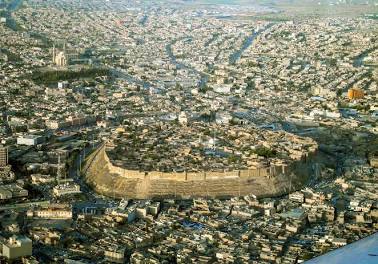
On Thursday, 26 November, thousands of residents took to the streets to protest outside the historic citadel in Erbil — the capital of the autonomous Iraqi Kurdistan. The demonstrators protested against a package of directives issued by the Iraqi Prime Minister, Ali al-Zaidi, which required federal agencies to take control of the region’s oil fields and border crossings. The escalation of the long-standing dispute between Baghdad and Erbil threatens to trigger a new political crisis in a country whose budget depends on oil revenues for around 90 per cent of its funding.
- Thousands of people took to the streets in Erbil to protest against the Iraqi government’s decisions regarding control over oil and the borders of Kurdistan.
- Iraq’s Prime Minister, Ali al-Zaidi, has transferred control of the oil fields in four disputed provinces to the federal Ministry of Oil.
- The authorities in Iraqi Kurdistan have described the directives as a breach of the constitution and an attempt to return the country to centralisation.
- Baghdad denied that army units had been deployed to the borders of the autonomous region and scheduled talks for 1 December.
What decisions has Baghdad taken, and what is happening in Erbil?
The mass protests outside the Erbil Citadel were triggered by a package of decrees issued by the office of the Iraqi Prime Minister Ali al-Zaydi On 24 November, following an investigation into large-scale smuggling of petroleum products at the state-owned North Oil Company, the federal government decided to tighten centralised control in several areas at once:
all official and unofficial border crossings within Iraqi Kurdistan are to come under the control of the federal Border Posts Directorate;
the export of crude oil and petroleum products from the region will require mandatory approval from the Iraqi Ministry of Oil;
The Federal Ministry of Oil is taking over the management of oilfields located within the provinces of Kirkuk, Nineveh, Salah ad-Din and Diyala;
As part of an anti-corruption campaign, the Prime Minister dismissed a number of security officials and civil servants, including the Chief of Police, the Commander of Operations in Kirkuk, and the Head of the Border Posts Directorate.
The following day, the Federal Supreme Court of Iraq upheld Baghdad’s actions, ruling that the central government had the right to deploy federal forces to guard all of the country’s international borders, including sections within Iraqi Kurdistan. At the same time, the court restricted the regional government’s administrative powers to the boundaries it controlled as at 19 March 2003.
Protesters at the rally in Erbil took to the streets carrying Kurdistan flags and holding placards in defence of the autonomous region’s constitutional and financial rights.
Erbil’s reaction and the federal government’s response
Baghdad’s directives have even brought together the two leading political forces in Iraqi Kurdistan — the Kurdistan Democratic Party (KDP) and the Patriotic Union of Kurdistan (PUK) — which, in a joint statement, described the federal government’s actions as crossing a «red line». The Prime Minister of the regional government Masrour Barzani described the decisions as unacceptable, whilst the autonomous region’s cabinet accused the central government of exerting pressure.
«These decrees violate both the Constitution and the constitutional rights of the Kurdistan Region and constitute an attempt to return Iraq to a centralised regime,» the Government of Iraqi Kurdistan stated.
Amid rumours on social media about preparations for a military scenario, a spokesperson for the Iraqi government Haidar al-Abudi officially denied reports of Iraqi army units being redeployed towards Kurdistan. According to him, the directives are aimed solely at smugglers who are pocketing «tens of billions» for themselves, whilst the payment of salaries to the autonomous region’s public sector employees is not a matter of dispute.
In a bid to find a political solution to the crisis, Iraq’s top leadership has agreed to hold a nationwide dialogue in Baghdad on 1 December. Tensions surrounding the Kurdish oil fields are escalating at a time when the Middle East is already facing heightened risks to its energy infrastructure — particularly following the recent attacks from Iraq on an oil pipeline in Saudi Arabia and disruptions on the routes through which a significant proportion of global oil consumption.