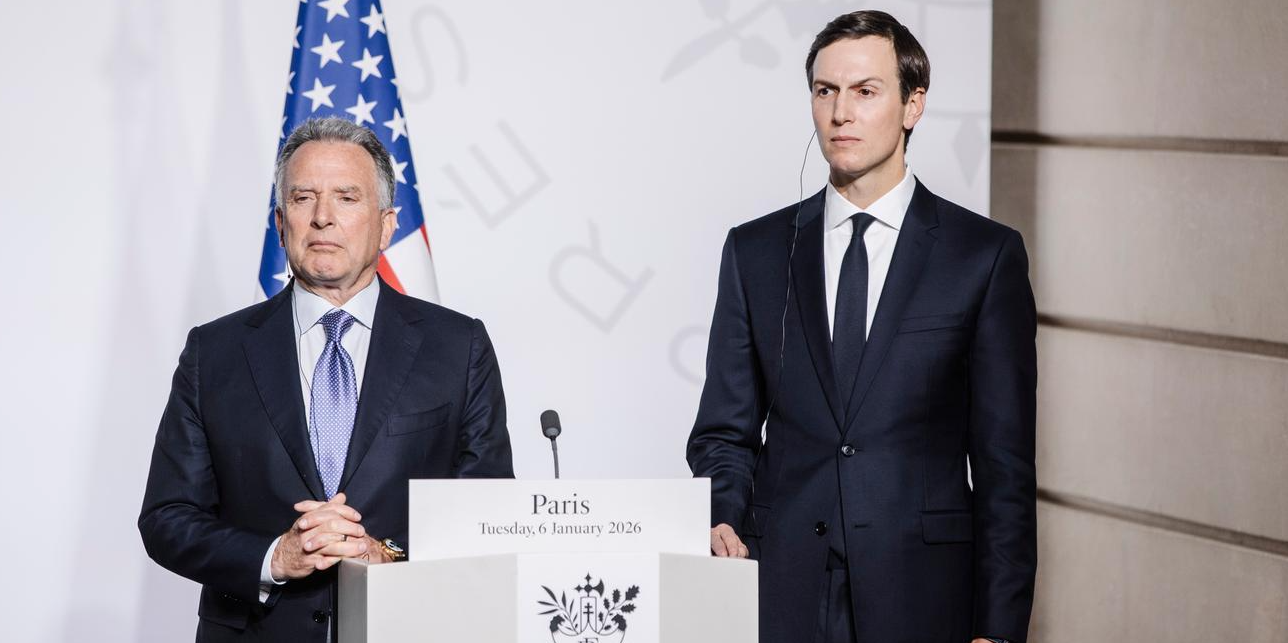
US President’s Special Representative Jared Kushner regards the former Russia–NATO Council as a model for future negotiations on European security. Washington is seeking to link a resolution to the war in Ukraine with broader agreements between Moscow and European states. However, US allies insist that a ceasefire in Ukraine must first be secured.
- Kushner regards the Russia–NATO Council as a model for future security talks.
- The US is proposing that talks on ending the war and on European security be held in parallel.
- European allies are insisting on a ceasefire in Ukraine as a matter of priority.
- Zelenskyy warned against a repeat of «Yalta 2.0» and the division of Europe.
The US wants to make use of the Russia–NATO Council format
According to The Washington Post, Kushner proposes launching a multilateral dialogue on the post-war security system in Europe in parallel with negotiations to end the Russian-Ukrainian war.
The guiding principle for the American negotiator is Russia–NATO Council, established in 2002 as a mechanism for consultation and cooperation between Moscow and the North Atlantic Alliance.
Following Russia’s occupation of Crimea in 2014, NATO suspended practical cooperation with Moscow, although political contacts continued for some time. The Council’s last meeting took place in January 2022, shortly before Russia’s full-scale invasion of Ukraine.
Kushner is currently considering this mechanism as a possible basis for new agreements. At the same time, there have been no reports of the official resumption of the Russia–NATO Council or of the allies agreeing to such a decision.
Europe refuses to discuss security until the war ends
The main point of contention between Washington and the European capitals concerns the sequence of the negotiations.
Kushner advocates for simultaneous discussions ceasefire in Ukraine and the future architecture of European security. European officials interviewed by *The Washington Post* consider this approach to be risky.
According to one of the publication’s sources, the allies are prepared to join the negotiations with Russia; however, agreements on the security of the entire continent can only be reached once the issue of a ceasefire has been resolved.
Another senior European official confirmed that there were significant risks, but stressed that it was in European countries’ best interests to participate in the diplomatic process rather than remain on the sidelines.
Kushner had previously outlined five areas for future agreements: ongoing security consultations, communication channels during crises, transparency regarding military activities, reciprocal measures to reduce the risk of escalation, and long-term stability in Europe.
Zelenskyy warned against a repeat of «Yalta 2.0»
President of Ukraine Volodymyr Zelenskyy He also spoke out against any discussion of a new security framework between Europe and Russia until the war is over.
In an interview with CNN, he stressed…that the primary objective must be to put an end to Russian aggression. The next step is to establish reliable security guarantees for Ukraine. Only then, according to the President, can we move on to broader agreements between Europe and Moscow.
Zelenskyy warned that any attempt to begin negotiations by revising the European security architecture could set a dangerous precedent, under which Russia would be able to influence the future of other states.
«We do not want “Yalta 2.0”. We do not want Russia to divide us,» the president said.
Talks in Abu Dhabi are scheduled for 10–11 November
A new US initiative is being discussed in the run-up to tripartite talks Ukraine, the US and Russia, which are due to take place on 10–11 November in Abu Dhabi.
The parties are expected to focus on possible terms for a ceasefire and security issues. The US delegation will be led by Jared Kushner and Steve Witkoff.
Vladimir Putin expressed interest in the idea of broader agreements on European security during a meeting with Steve Witkoff on 21 October in St Petersburg. Kushner took part in the discussion remotely.
Despite the intensification of diplomatic contacts, the parties have not yet announced that they have agreed on the terms of a ceasefire or on the establishment of a new negotiating mechanism between Russia and NATO.