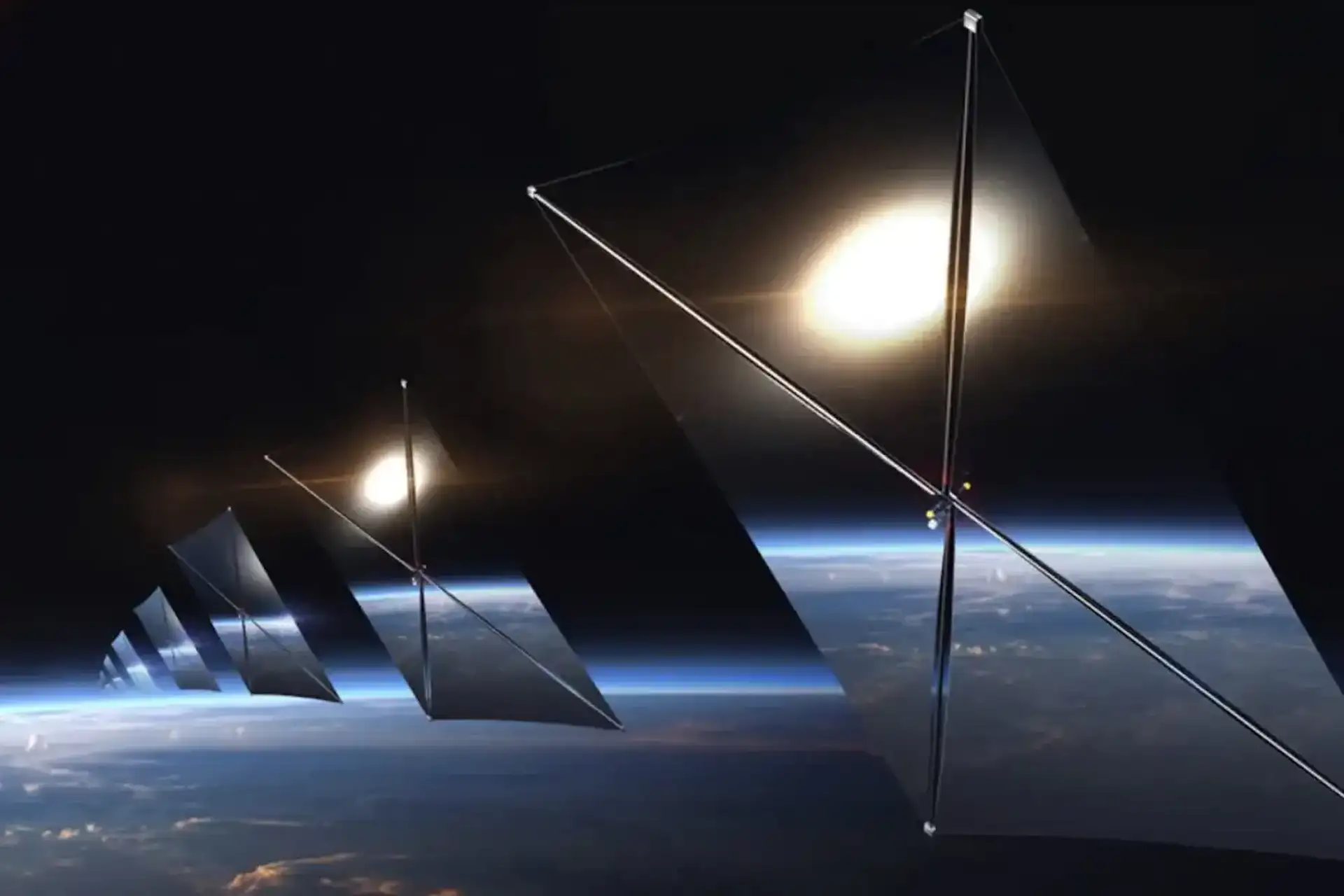
The Californian start-up Reflect Orbital plans to create a constellation of over 50,000 mirror satellites by 2035, which will direct sunlight onto specific areas of the Earth after sunset. The FCC has granted a licence for a single demonstration satellite, Eärendil-1, but DarkSky International and its partners have challenged this decision, seeking an environmental assessment.
Briefly about the main points
- The Reflect Orbital plan envisages more than 50,000 mirrors by 2035.
- The initial test is designed for light levels comparable to moonlight.
- The FCC has licensed a single demonstration unit, not a future network.
- A coalition of organisations is calling for the decision and the environmental assessment procedure to be reviewed.
- The launch and successful orbital testing of Eärendil-1 have not been publicly confirmed.
How the company proposes to direct light towards Earth
Reflect Orbital proposes installing controllable mirrors on satellites to reflect sunlight onto specific areas of the Earth’s surface. According to the company’s plan, the illumination can be stopped by rotating the satellite, and its intensity can be adjusted by deploying different numbers of satellites.
In its plan for 2026, the start-up specifies a target illuminance of around 0.1 lux for five minutes and compares this to moonlight. Possible areas of application include search and rescue operations, remote industrial sites, agriculture and support for solar energy; these are the project’s stated objectives, not the results of its work.
A Gizmodo article published in March mentioned a figure of around 5,000 dollars per hour of light from a single mirror. This was a preliminary commercial proposal, not a current, confirmed rate.
The demonstration mission has not yet produced any confirmed results
The first spacecraft is set to be Eärendil-1. The project’s preprint states that satellite It is designed to deploy a mirror measuring approximately 18 by 18 metres and create a light spot with a diameter of around five kilometres. Reflect Orbital explains that the mission is intended to test the technology and safety mechanisms, and to collect data in real-world conditions.
On 17 July, the company announced that it had received a licence from the US Federal Communications Commission to launch a demonstrator into low Earth orbit. Separately, on 1 September, the FCC granted RBC Signals a temporary authorisation to communicate with the satellite via a station in Deadhorse, Alaska: this authorisation is valid from 2 September to 31 October and covers telemetry, command and data transmission.
The establishment of ground-based communications does not confirm the launch or operation of the mirror in orbit. There is currently no public confirmation of a successful orbital test of Eärendil-1.
The coalition is asking the FCC to carry out an environmental assessment
On 6 August, DarkSky International, the American Bird Conservancy, Environment America and Public Employees for Environmental Responsibility filed a petition for a review of the FCC’s Space Bureau’s decision. The coalition is calling for the authorisation to be revoked and for a proper environmental assessment to be carried out.
Organisations warn that controlled night-time lighting could interfere with astronomical observations, affect wildlife and add large objects to orbit. This concerns an assessment of the potential risks of the technology, rather than the consequences of an existing constellation.
In its submission, the coalition also proposed an alternative to revoking the licence — to impose mandatory conditions, including independent calculations of light pollution, advance notice of lighting and buffer zones around observatories. These are the applicants’ requirements, not the current conditions of the licence. The FCC has not publicly announced a timeframe for the full review of the application.
Reflect Orbital promises to limit brightness and the areas illuminated
The company recognises the need to take into account the interests of astronomers, local communities and nature conservation. It states that it must demonstrate its ability to precisely control the illumination area, brightness and duration, as well as to measure its actual impact.
In the case documents, Reflect Orbital stated its intention to make orbital information available in advance, to avoid observatories and protected sites by means of geozones, and to change the orientation of the mirror whilst in standby mode to reduce its visibility. The company also stated that it was prepared to change its approach if the trials did not confirm the system’s viability.
At present, the procedure relates to the demonstrator, and its licence is under review following a request from the coalition. Scaling up the project will require separate technical and regulatory assessments.