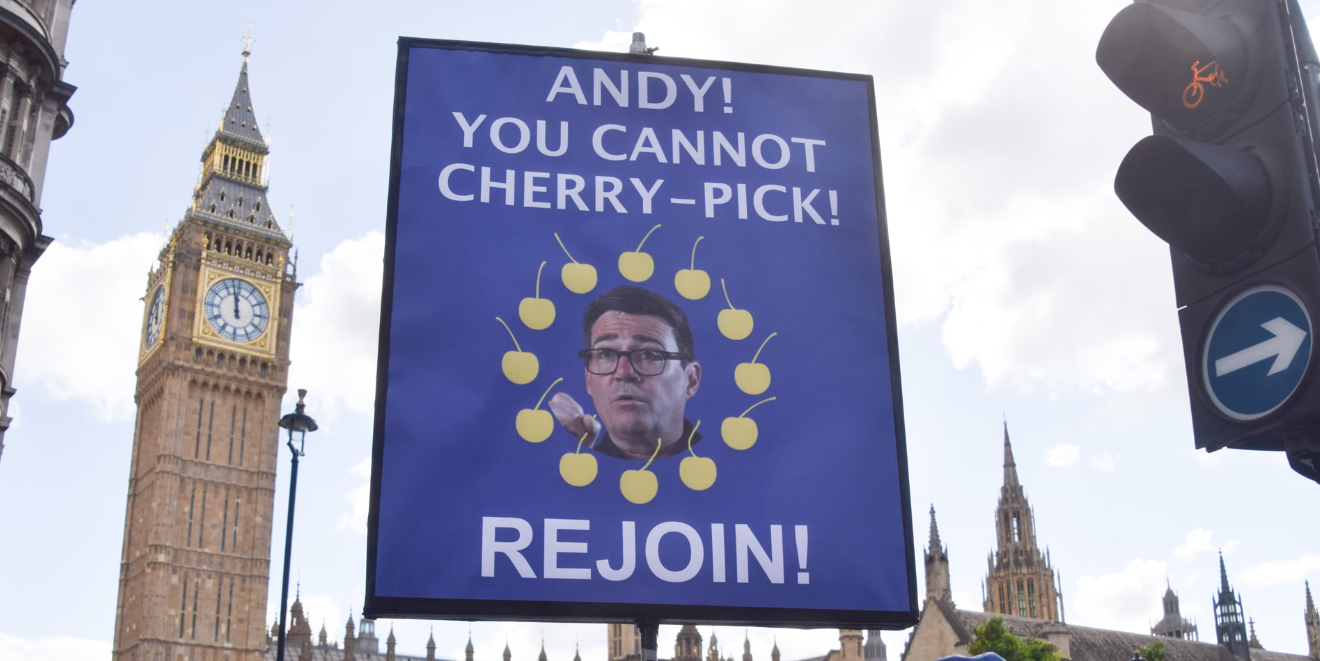
The Guardian reported on 3 October that 49% of those surveyed by TMG supported the UK rejoining the EU, whilst 28.5% were against it. The figures emerged against the backdrop of statements by Prime Minister Andy Bernam regarding the need to discuss the country’s long-term relations with Europe; however, the government has not announced any decision to apply for membership.
Briefly about the main points
- The Guardian reported that 49% supports re-entry into the EU, according to a TMG study.
- TMG surveyed 11,461 people between 12 and 24 September, according to the publication.
- Burnam is talking about options for relations with Europe, not about confirmed accession.
- Re-accession would require the procedure set out in Article 49 of the Treaty on European Union.
What the TMG survey revealed
Pros. message The Guardian and the Messina Group surveyed 11,461 people between 12 and 24 September 2026, weighting the sample according to the result of the 2016 referendum. Of the seven proposed options for relations with the EU, re-entry proved the most popular: 49% of respondents supported it, whilst 28.5% were against it.
The second most popular option was to maintain the current model of relations whilst minimising trade barriers — 48.2% in favour and 20.9% against. The Customs Union was supported by 47.1% of respondents, whilst a further distancing from the EU was backed by 27.9%; 41.2% opposed the latter scenario. This shows that, in the survey, closer forms of cooperation garnered more support than a course towards further distancing.
At the same time, the full TMG report, the exact wording of the questions, the weighting tables and the data on the margin of error were not publicly available for independent verification. These figures should therefore be regarded as data from the survey reported by The Guardian, rather than as an independently verified measure of public opinion.
What political impact does the study predict?
TMG modelled the impact of various political messages on support for Labour. According to these calculations, scenarios involving closer ties with the EU could boost the party’s support by between 4.3 and 7.4 percentage points; the greatest effect, according to the publication, was predicted in the event of a promise to hold a new referendum, in which Labour would campaign for a return to the bloc.
Separately, the publication cites the following results: 52.4% of respondents reportedly consider leaving the EU to be a mistake, whilst 54.9% regard it as a failure. These figures are subject to the same methodological limitations, as TMG’s raw data has not been made public.
The Guardian’s report on possible differences of opinion amongst ministers regarding the pace of integration with the EU is largely based on anonymous sources. These should not be interpreted as the officially confirmed position of the entire cabinet.
What Andy Burnham actually said
Andy Burnham has held the post of Prime Minister of the United Kingdom since 20 July 2026, according to information from the British Government. At the end of September, he stated that it was necessary to consider long-term options for the country’s relations with Europe; among the possibilities, he mentioned a complete re-negotiation accession to the EU.
This does not mean that the government has already committed to a course towards membership or intends to begin negotiations immediately. Government statements confirm a general commitment to more active engagement with Europe, but do not contain any announcement regarding the submission of an application to the EU.
The current relationship between London and Brussels is based on the Withdrawal Agreement, the Windsor Framework and the Trade and Cooperation Agreement. In a joint document following the summit in May 2025, the parties stated their intention to strengthen cooperation within this legal framework.
Why closer ties with the EU do not mean a return to the bloc
Closer cooperation on trade, security or other matters may take place within the framework of existing agreements between the UK and the EU. Re-accession would be a separate legal and political process, rather than an automatic continuation of such closer ties.
Article 49 of the Treaty on European Union provides for a formal application by a candidate country, a unanimous decision by the Member States in the Council of the EU, the consent of the European Parliament, and the ratification of the accession treaty by all parties in accordance with their respective constitutional procedures. Consequently, even a political decision by London in favour of membership would not, in itself, mean Britain’s return to the EU.