
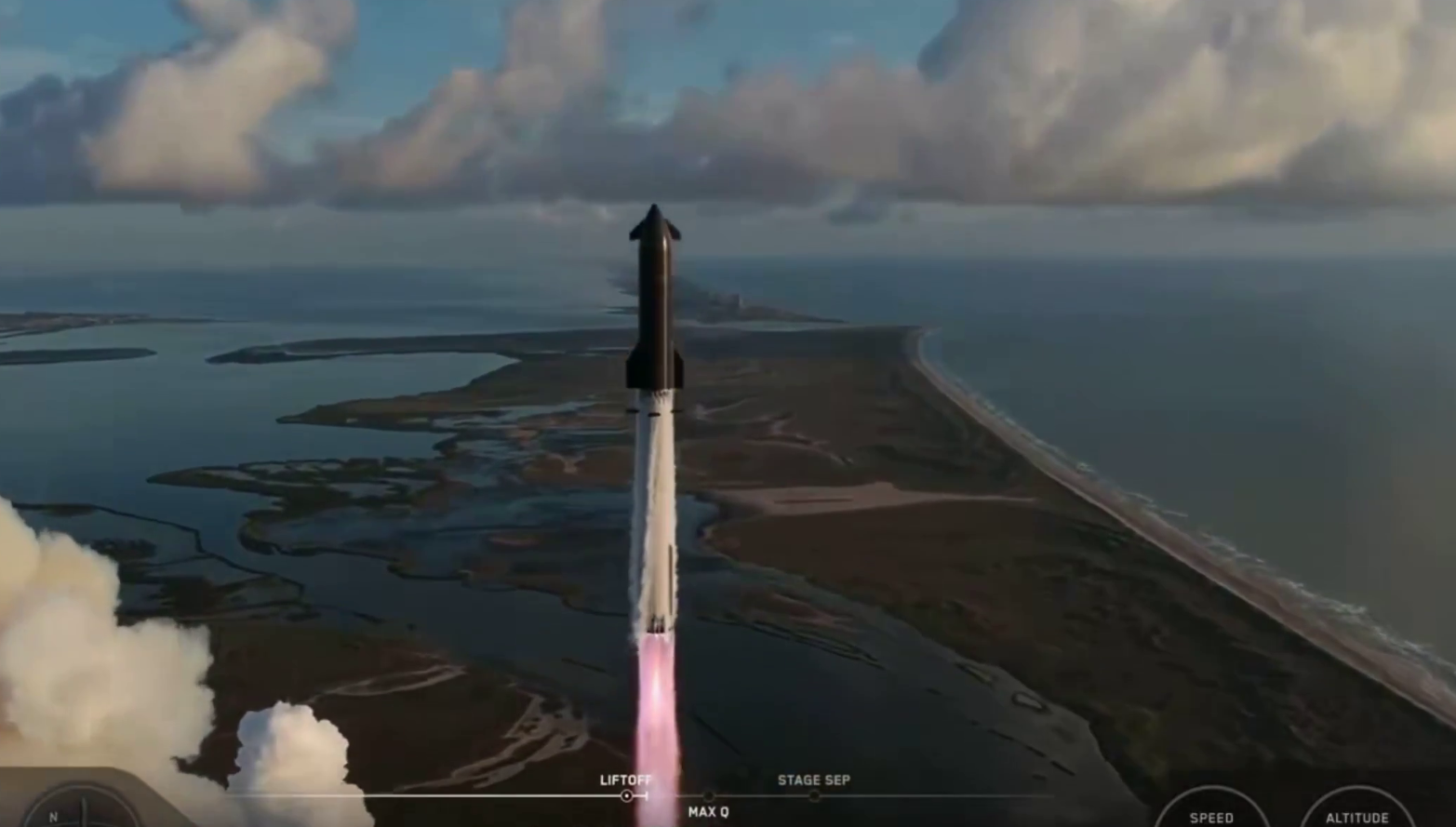
SpaceX has carried out the most significant Starship launch in the programme’s history. During its 14th test flight, the giant rocket entered a stable Earth orbit for the first time and began deploying 26 next-generation Starlink V3 satellites. The mission is ongoing — it will complete several orbits around the Earth, deorbit and make a controlled splashdown in the Pacific Ocean.
- For the first time in history, Starship has entered orbit.
- This is the system’s 14th test flight.
- There are 26 Starlink V3 satellites on board.
- Whilst climbing, one of the engines cut out prematurely.
- Super Heavy successfully carried out a controlled splashdown.
- The Starship flight is expected to last around 10 hours.
Starship has reached orbit for the first time
Starship began on 28 September with Starbase in Texas. This is Flight 14 — the fourteenth joint flight of the Starship and the Super Heavy booster.
The previous 13 tests followed suborbital trajectories. This time, for the first time, SpaceX set the system the task of reaching a full Earth orbit, and Starship succeeded.
After the Super Heavy stage separated, the spacecraft continued to gain speed and altitude. Once in space, it carried out the necessary manoeuvre and for the first time in the programme’s history, it entered Earth’s orbit.
An engine problem arose during the flight
There were some technical problems. During the ascent One of Starship’s three main engines shut down earlier than planned. To begin with, the team SpaceX She even reported that the spacecraft might not be able to enter orbit as a result. Within a few minutes, the engineers had reassessed the situation. There proved to be sufficient performance margin, and Starship was given clearance to continue the orbital manoeuvre. The engine was fired, and the spacecraft successfully entered its planned orbit.
Starship delivers real satellites for the first time
Flight 14 is significant for another reason: this time, the Starship isn’t just being tested. On board are 26 operational Starlink V3 satellites — SpaceX’s new-generation satellite system.
After entering orbit, the spacecraft began to release them in stages at an altitude of approximately 269 km above the Earth. This is the first deployment of an actual orbital payload using Starship.
How does Starlink V3 differ from previous versions?
The new satellites are significantly larger and more powerful than the Starlink V2 Mini satellites currently being launched on Falcon 9 rockets. According to SpaceX, a single Starlink V3 satellite is capable of transmitting approximately ten times as much data, than the previous generation. Once Starship begins regular flights, SpaceX plans to launch approximately 60 such satellites per mission.
Super Heavy has returned to the Gulf of Mexico
After separating from Starship, the Super Heavy first stage performed a manoeuvre and began its return to Earth.
This time, SpaceX did not attempt to recover the booster using the Mechazilla tower. Super Heavy performed a landing manoeuvre using its engines and It was deliberately sunk in the Gulf of Mexico. For SpaceX, this is also an important achievement following issues with hard landings during previous flights. Reuters
Starship is due to make six orbits around the Earth
That’s not the end of Flight 14. The plan envisages approximately six revolutions round the Earth. The total duration of the mission is expected to be approximately 10 hours — This is Starship’s longest flight to date.
Once the orbital phase is complete, the spacecraft must:
- restart the Raptor engine in space;
- to leave orbit;
- to pass through the dense layers of the atmosphere;
- check the heat shield;
- perform the final turn;
- is expected to form in the Pacific Ocean, west of Chile.
There are no plans to return the spacecraft itself to the launch pad during Flight 14.
Why is this launch crucial for SpaceX?
Reaching orbit was one of the key milestones of the entire Starship programme. The system is being developed as a fully reusable super-heavy-lift rocket capable of carrying significantly more payload than the Falcon 9. It is onto the Starship that SpaceX plans to gradually transfer a significant proportion of its Starlink launches.
The ship is also a key part of monthly programme NASA Artemis. A modified version of Starship is to be used as a lander to transport astronauts to the surface of the Moon.
The main challenge for Flight 14 will now be the spacecraft’s return. If Starship successfully completes a long orbital flight, deorbits and re-enters the atmosphere, SpaceX will gain several key confirmations of the system’s readiness for regular cargo missions.