Google appears to be working on a new fitness tracker Fitbit Edge, which is set to occupy a middle ground between the minimalist, screenless Fitbit Air and the fully-fledged Pixel Watch 5. Retail materials featuring photographs and specifications of the unannounced device have appeared online: it is said to feature a colour display, GPS, an altimeter, support for Google Maps, notifications from a smartphone and up to seven days’ battery life. Google has not yet officially unveiled the Fitbit Edge.
- Images and specifications of the unannounced Google Fitbit Edge have appeared online.
- The wristband may feature a colour display, GPS, an altimeter and automatic workout recognition.
- The advertised features include Google Maps, music control, Find My Phone and notifications.
- According to the leaked information, the battery life will be up to seven days.
What will the Google Fitbit Edge be like?
A new leak has, in fact, revealed for the first time how Google might return to the classic Fitbit design with a display.
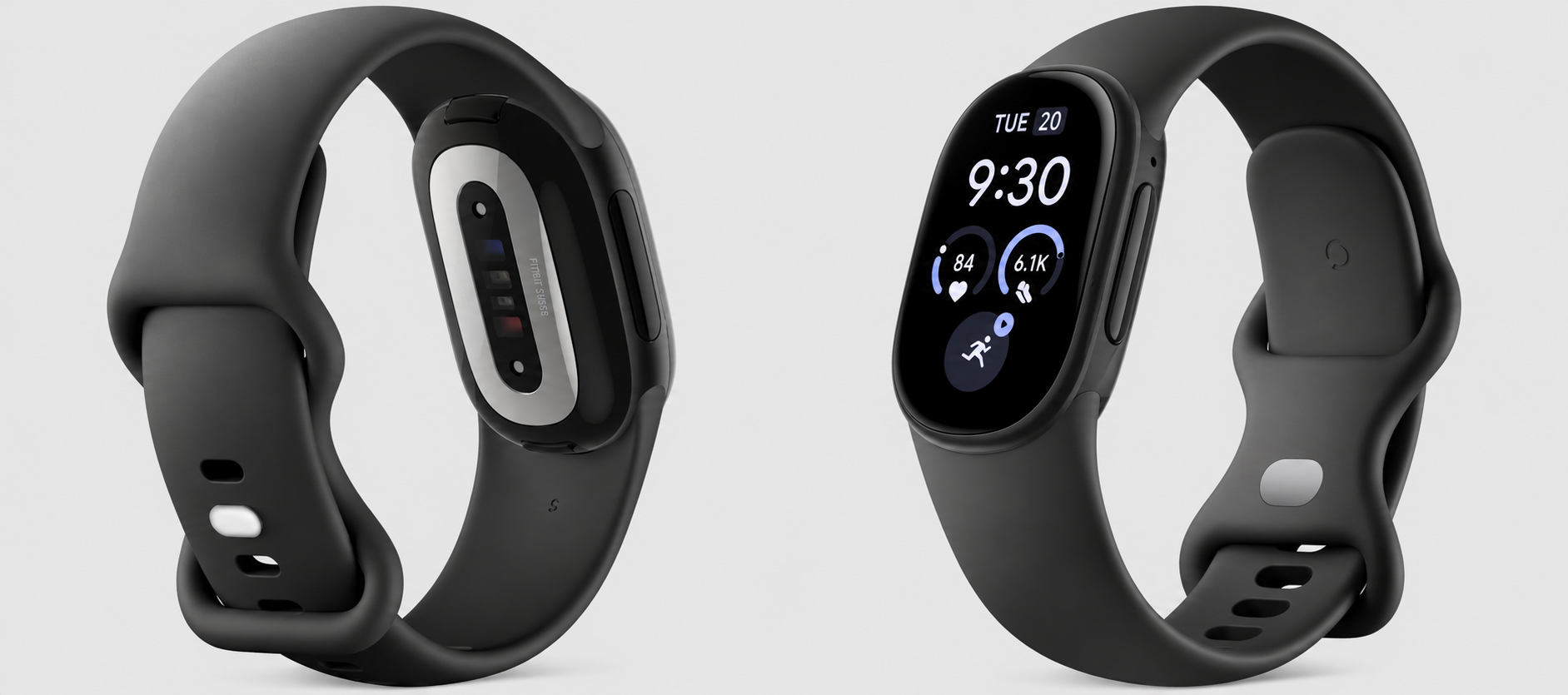
The renders that have been released show a compact wristband with a rounded, almost oval screen. It takes up a significantly larger portion of the front panel than on previous trackers Fitbit. The interface resembles a customised version of the Pixel Watch face: the screen can display the time, date, heart rate, step count and a quick workout launch button all at once. On the back, there is a sensor array and a quick-release strap mechanism. In terms of design, the sensors are more reminiscent of the Fitbit Air than the Pixel Watch.
GPS and altimeter without a smartphone
According to the leak, the Fitbit Edge will feature built-in GPS, so you’ll be able to record your running, walking and cycling routes without having to use your smartphone all the time.
Another notable difference is — altimeter. It will enable you to measure elevation changes and the number of floors climbed, and to track your activity more accurately whilst hiking or running across varied terrain.
Automatic recognition of physical activity is also expected — the wristband will be able to track workouts even if the user forgets to start it manually.
Google Maps and music right on your wristband
It is the screen that may be the main difference between the Edge and the Fitbit Air.
The leaked documents list the following features as supported:
- Google Maps;
- music and media control;
- Find My Phone;
- notifications from a smartphone;
- step and heart rate data;
- Quick start to your training sessions.
A fully-fledged app store, like the one on the Pixel Watch, is not expected. It seems Google will deliberately keep the Fitbit Edge simpler than a smartwatch, but more feature-rich than a standard fitness tracker.
Up to seven days without charging
Another strong point of the new device is its battery life. A leak suggests that up to seven days’ use on a single charge. It’s much closer to traditional Fitbits than to full-fledged Wear OS smartwatches.
The Fitbit Edge is also expected to support both Both Android and iOS, whilst the Pixel Watch is designed for Android. The connection will be via Bluetooth; there is no mention of Wi-Fi support in the leaked comparison table.
For users iPhone This could make Edge an attractive alternative to more expensive smartwatches, provided Google maintains full synchronisation of the core functions.
Three colours and a revamped design
In the images released, the Fitbit Edge is shown in at least three colours — black, green and orange. They resemble shades of Obsidian, Olive and Canyon, which Google uses in its current range of devices. Metal inserts are visible on the sides of the body. 9to5Google suggests that these could potentially be used to measure an ECG, although there is currently no confirmation of this feature. Therefore, it should not yet be regarded as a feature of the final device.
This could be the successor to the Fitbit Charge 6
Google has not released a new standard Fitbit Charge since Charge 6 in 2023. That is precisely why the Edge is increasingly being seen as the de facto successor to this series. The design is very similar: a compact body, a display, health sensors, GPS and long battery life — without any attempt to turn the device into a fully-fledged watch. The Verge
In Google’s current range, it logically sits in the middle:
Fitbit Air — the simplest version without a display.
Fitbit Edge — a fitness tracker with a screen and basic smart features.
Pixel Watch 5 — a fully-fledged smartwatch running Wear OS, with a wider range of apps and services.
This may mean that Google is, in fact, developing three tiers of wearable devices to cater for different needs.
Google accidentally revealed it even earlier
Back in August, observant users spotted an unidentified fitness tracker in the Pixel 11 promotional materials. At the time, it was not possible to identify the model. In September, details of a similar device appeared in FCC documents, and now retail materials have effectively linked the previous leaks to the name Fitbit Edge.
In other words, the device appears to have moved beyond the early prototype stage and is now much closer to a commercial launch.
When will the Fitbit Edge be released and how much will it cost?
No official launch date has been announced yet. Some specialist publications suggest that Google may unveil the Fitbit Edge as early as October, so that the device can go on sale in time for the winter shopping season. This, however, is currently only a prediction based on a leak, not a confirmed date.
Similarly, the price has not been confirmed. Specialist media outlets are citing an approximate range $149–199, based on its positioning between the Fitbit Air and the Pixel Watch. Google has not disclosed this figure.
It is the official announcement that should answer the key questions: what sensors the Edge will feature, whether it will support ECG, how much it will cost, and when it will go on sale.