
Global oil prices have experienced one of the sharpest falls in recent months. Following the Democrats’ victory in the US mid-term congressional elections, Brent crude lost 8.7 per cent in a single trading session, whilst US WTI fell by 8.3 per cent. On Thursday, 5 November, prices continued to fall amid expectations that the Republicans’ political defeat would force Donald Trump’s administration to seek a diplomatic resolution to the war with Iran. Over the course of a few days, Brent lost around a fifth of its value, but analysts warn that the risk of another price spike remains high.
- On 4 November, Brent crude fell by 8.7 per cent, whilst US WTI fell by 8.3 per cent.
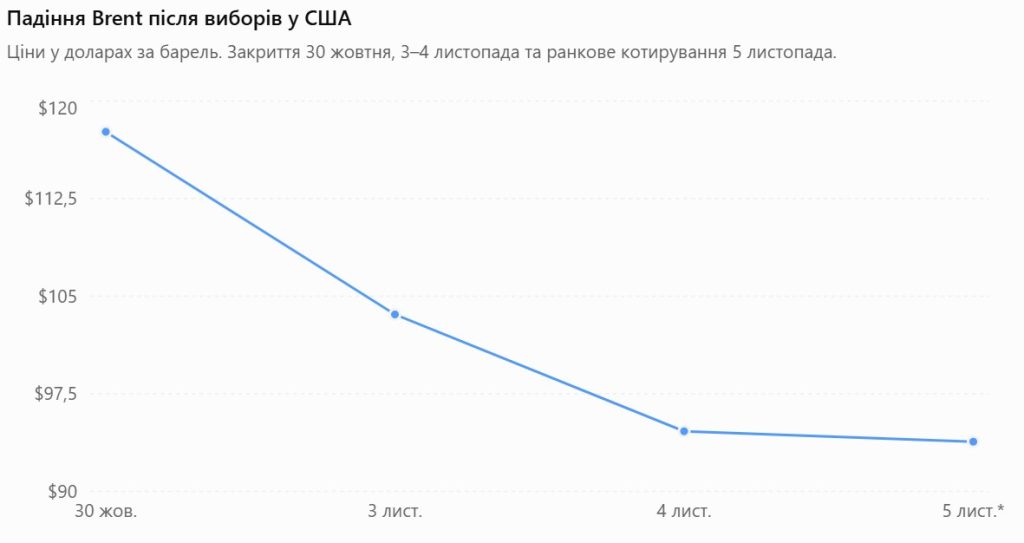
- On the morning of 5 November, the price of Brent fell below $94 a barrel.
- Investors expect the risk of an escalation of the war between the US and Israel against Iran to decrease.
- JPMorgan estimated the global oil supply surplus in October at 1.4 million barrels per day.
- Analysts are warning that Brent could rise back to $110–125 should the situation escalate.
Brent and WTI have fallen to their lowest levels since August
At the close of trading on 4 November, Brent crude oil futures fell by $8.98, or 8.7 per cent, to $94.62 per barrel. US West Texas Intermediate lost $7.97, or 8.3 per cent, closing the session at $88.12.
For both benchmark grades, these were the lowest closing prices since 31 August 2026.
On Thursday morning, the decline continued for the fourth consecutive trading session. As of 04:26 GMT, Brent had fallen a further 0.85 per cent to $93.82 per barrel, whilst WTI had lost 1.36 per cent and was trading at $86.92.
Back in late October Brent cost around $118. Thus, in less than a week, the global oil market went from a sharp rise in prices against a backdrop of military risks to a massive sell-off of commodity contracts.
What is distinctive about the current fall is that the physical risks to oil supplies from the Middle East have not entirely disappeared. Investors are, first and foremost, reassessing the likelihood of the war escalating further and the possible return of Iranian and regional supplies to the global market.
The Democrats’ victory has changed expectations regarding the war with Iran
A sharp shift in sentiment on the oil market occurred after the US mid-term elections 3 November, when the Democratic Party gained control of the House of Representatives and the Senate.
The Republicans lost their majority in Congress amid voter discontent over the rising cost of living and the consequences of the US-Israeli military campaign against Iran.
According to market participants, the new political balance in Washington could make it more difficult to fund further escalation and increase pressure on the White House to return to the negotiating table.
Two Reuters sources close to government circles in the Gulf states have noted that, following the election, President Trump now has greater political incentives to seek agreements with Tehran. They also consider a new full-scale offensive against Iran to be less likely.
Senior oil market analyst at Sparta Commodities Joon-ho She explained that traders are taking the results of the US election into account as they assess Trump’s next moves and the prospects for an end to the war.
However, the prospect of talks does not mean that a diplomatic settlement is imminent. The United States and Iran continue to have serious differences, and the US President has broad powers in the field of foreign policy, even with an opposition majority in Congress.
Supplies via the Strait of Hormuz are gradually resuming
Another factor contributing to the fall in prices was the partial resumption of oil shipments through the Strait of Hormuz — one of the key routes for energy supplies from the Persian Gulf.
During the war, shipping in this region was severely disrupted. The risks to tankers, rising insurance premiums and export restrictions created a shortage in the market and prompted oil prices up.
According to analysts’ estimates, the volume of crude oil transported through the strait has now almost returned to pre-war levels. However, transport costs remain higher due to insurance costs and security risks.
The gradual resumption of supplies is increasing the volume of raw materials available on the global market and allaying fears of a prolonged shortage.
At the same time, the resumption of maritime transport does not mean that the situation has returned to normal. Any new escalation in the region could disrupt transport once again and cause a sharp change in prices.
JPMorgan has reported a return to a surplus in the oil market
Analysts at JPMorgan believe that the global oil market has already shifted from a shortage to a surplus.
According to the bank’s estimates, global supply exceeded demand by approximately 1.1 million barrels per day in September. In October, the surplus rose to 1.4 million barrels per day.
By way of comparison, the average supply surplus over the previous year stood at around 1.3 million barrels per day.
The shift in the balance is due to the gradual resumption of supplies from the Gulf states following prolonged disruptions caused by the war.
However, the current production surplus does not mean that the global market is completely immune to further shocks.
According to the head of the energy consultancy firm XAnalysts Mukesh Sahdeva, commercial oil stocks in major consumer countries remain close to their lowest levels in the last 15 years.
This limits the market’s ability to quickly compensate for a large-scale reduction in supply in the event of a new military escalation.
Analysts do not rule out Brent returning to $125
Despite the sharp fall in prices, leading financial institutions do not consider the risk of further escalation to have been eliminated.
Analysts at Citi note that, following the US election, the White House may make more active use of presidential powers in the field of foreign policy, in particular to launch new military operations.
The consultancy firm Eurasia Group has lowered its assessment of the likelihood of further US strikes on Iran from 65 per cent to 60 per cent. At the same time, the predicted likelihood of a diplomatic agreement has also fallen — from 20 per cent to 10 per cent.
Analysts have raised the probability of a protracted conflict without a full-fledged peace settlement from 15 per cent to 30 per cent.
Consequently, even following the change in the political majority in the US, experts do not expect a swift and certain end to the conflict.
According to the Eurasia Group, should there be a new military escalation, the price of Brent could return to the $110–125 per barrel range.
Such fluctuations suggest that the current decline is largely linked to a reassessment of geopolitical expectations, whilst fundamental supply risks remain significant.
What the fall in oil prices means for the global economy and Ukraine
The fall in global oil prices is likely to ease the inflationary pressure that has intensified as a result of the war in the Middle East.
Rising oil prices have a direct impact on the production of petrol, diesel and aviation fuel. Ultimately, the increase in fuel costs is reflected in the cost of transport, industrial goods and consumer goods.
Therefore, a sharp fall in commodity prices could be a positive sign for economies that are dependent on energy imports. At the same time, a fall in oil prices does not always lead immediately to a reduction in retail fuel prices.
In Ukraine. the price of petrol The price of diesel depends not only on global market prices, but also on the prices of refined petroleum products in Europe, exchange rates, logistics, excise duties and other tax components.
If the fall in global prices proves to be prolonged, it could pave the way for a gradual reduction in the price of imported fuel. However, it is too early to predict a specific fall in prices at Ukrainian petrol stations based solely on current exchange data.
At the same time, cheaper oil means a potential reduction in export revenues for oil-producing countries, particularly Russia. The actual impact on the Russian budget will depend on the price of exported crude grades, sales volumes, discounts granted to buyers and the exchange rate.
On Thursday, 5 November, the oil market continued to react to political developments in Washington, but market participants are also keeping a close eye on actual supply volumes from the Persian Gulf. It is precisely this combination of diplomatic decisions and the physical balance of oil that will determine future price movements.