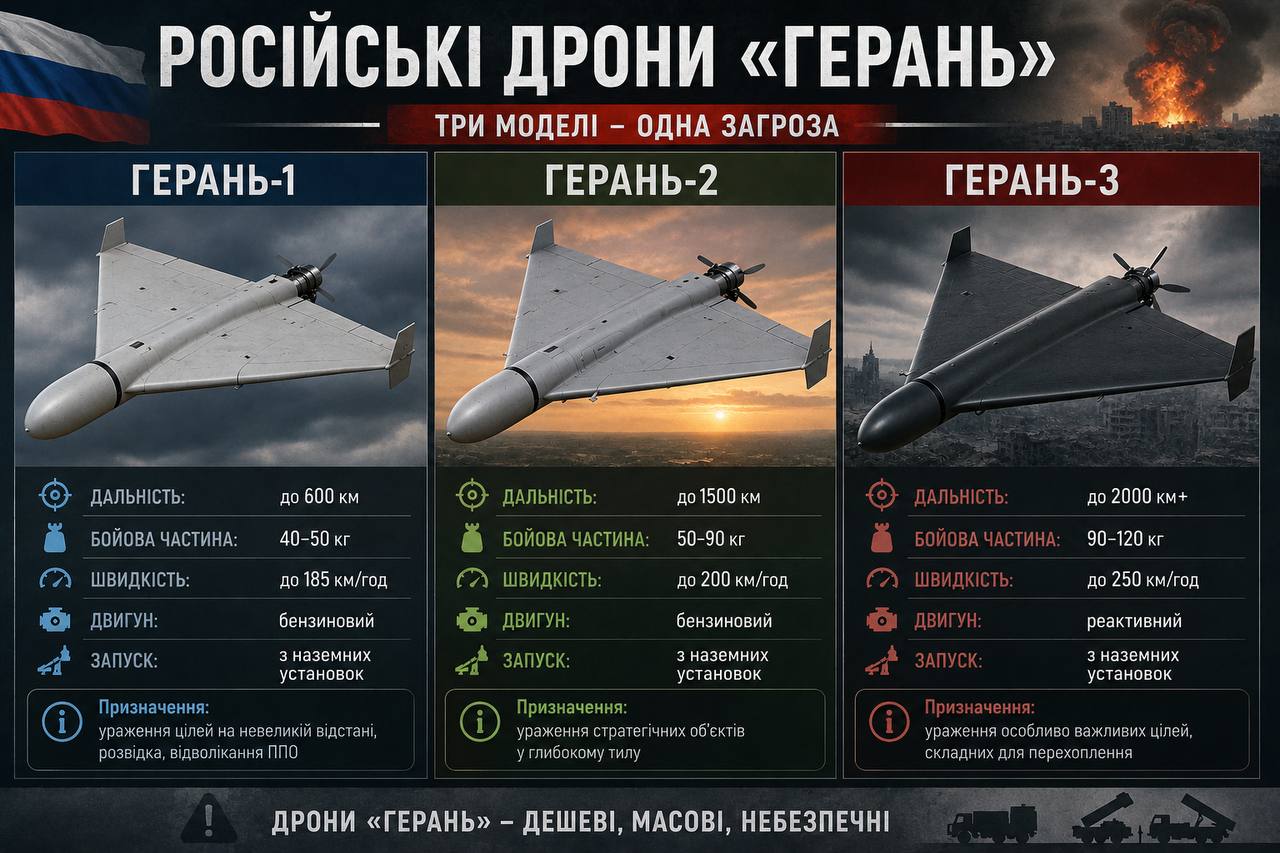
Over the years of the full-scale war, Russian Geranium series attack drones have become one of the key elements of Russia's air campaign against Ukraine. Relatively cheap to manufacture, the drones allow Moscow to regularly attack Ukrainian cities, energy infrastructure and military facilities. While the first models were actually copies of Iranian Shahed, the new modifications demonstrate Russia's attempt to create its own multi-level system of attack UAVs, from massive «depletion drones» to jet drones to break through air defences.
How Russia got Gerani«
The first Geranium-1 and Geranium-2 appeared after the start of military-technical cooperation between Russia and Iran. They were based on Iranian Shahed-131 and Shahed-136.
Initially, drones were supplied directly from Iran, but later Russia localised production on its own territory. The main production centre is associated with Tatarstan.
The main advantage of these drones:
- low cost;
- ease of production;
- the possibility of a mass launch;
- depletion of air defence systems.
Unlike cruise missiles, which can cost millions of dollars, Geraniums are much cheaper, allowing Russia to launch dozens or even hundreds of them in a single attack.
«Geranium-1: a drone for mass attacks
«The Geranium-1 has become the basic model of Russian attack drones. It is used for:
- strikes on energy facilities;
- attacks on warehouses;
- air defence overload;
- psychological pressure on the population.
Characteristics of Geranium-1«
| Parameter. | Meaning. |
|---|---|
| Range | up to 600 km |
| Combat unit | 40-50 kg |
| Speed | up to 185 km/h |
| Engine. | petrol |
| Type of launch | ground installation |
Due to their relatively low speed, these drones are often shot down by mobile fire teams, but their massive size remains a major problem.
Russia regularly uses Geranium-1 during night attacks on Ukrainian cities.
«Geranium-2»: the main instrument of attacks on Ukraine
It is «Geranium-2» has become a symbol of Russian attacks on Ukraine. These drones are regularly attacked:
- Kyiv;
- Odesa;
- Kharkiv;
- Dnipro;
- ports;
- power plants;
- logistics centres.
Main characteristics of «Geranium-2»
| Parameter. | Meaning. |
|---|---|
| Range | up to 1500 km |
| Combat unit | 50-90 kg |
| Speed | up to 200 km/h |
| Navigation | GPS/GLONASS |
| Engine. | petrol |
Russia is constantly upgrading these drones:
- changes the navigation antennas;
- improves protection against EMP;
- improves flight routes;
- uses new guidance algorithms.
Particularly dangerous are combined attacks, The company's newest product, the Gerani, is launched simultaneously with the
- cruise missiles;
- ballistic missiles;
- aviation ammunition.
Such strikes overload the air defence system and make it difficult to intercept targets.
«Geranium-3: a new generation of jet drone
One of the most dangerous upgrades was the Geranium-3. According to preliminary estimates, this drone may receive a jet engine.
Why is Geranium-3 dangerous?«
| Parameter. | Meaning. |
|---|---|
| Range | over 2000 km |
| Speed | up to 250 km/h |
| Combat unit | 90-120 kg |
| Engine. | reactive |
| Main role | air defence breakthrough |
Jet propulsion makes it possible:
- reduce air defence response times;
- increase the speed of the attack;
- increase the complexity of interception.
Analysts believe that Geranium-3 can be used for:
- attacks on critical infrastructure;
- breakthrough of air defence systems;
- attacks on strategic targets;
- combined massive strikes.
«Geranium-5: a potential new threat
Special attention of military experts is drawn to reports of the possible development of «Geranium-5». There are no official specifications yet, but analysts suggest that Russia is working on an even more sophisticated attack drone.
Probable characteristics «Geranium-5»
| Parameter. | Probable characteristics |
|---|---|
| Range | over 2500 km |
| Speed | up to 300 km/h |
| Combat unit | 120-150 kg |
| Engine type | reactive or combined |
| Navigation | autonomous + satellite |
It is expected that the new model can get:
- elements of artificial intelligence;
- automatic air defence bypass;
- group coordination of drones;
- change of route in flight;
- Sophisticated attack algorithms.
Comparison of all Geranium models«
| Model. | Range | Speed | Combat unit | Main purpose |
|---|---|---|---|---|
| Geranium-1 | up to 600 km | up to 185 km/h | 40-50 kg | mass attacks |
| Geranium-2 | up to 1500 km | up to 200 km/h | 50-90 kg | strategic strikes |
| Geranium-3 | over 2000 km | up to 250 km/h | 90-120 kg | air defence breakthrough |
| Geranium-5 | over 2500 km | up to 300 km/h | 120-150 kg | autonomous attacks |
Russia's tactics during the «Geranium» attacks»
1. Massive waves of launches
Russia launches dozens of drones simultaneously, overloading air defences.
2. Night strokes
Most attacks occur at night to make detection more difficult.
3. Combined attacks
Drones are used in conjunction with various types of missiles.
4. Depletion of Ukrainian air defence
Russia is trying to force Ukraine to spend expensive missiles on cheap drones.
Why Geraniums have become the main weapon of terror
Russia uses these drones not only for military purposes. The main goal:
- psychological pressure;
- creating panic;
- destruction of the energy sector;
- economic exhaustion;
- logistics disruptions.
Drones were used especially actively during the war:
- attacks on the power system;
- winter blackouts;
- strikes on ports;
- shelling of residential areas.
Because of the distinctive sound of the engine, the Gerani became a symbol of the air threat for Ukrainians.
How Geranium's attack tactics are changing in 2026
In 2026, Russia significantly changed its approach to the use of Shahed/Geranium attack drones. Whereas previously drones were used mainly as a cheap tool to attack energy infrastructure, they have now become part of a comprehensive tactic to deplete Ukraine's air defence system.
Analysts point to a sharp Increase in the number of drone launches, and the emergence of new modifications with improved navigation systems, EW resistance and modified flight routes.
Estimated dynamics of Shahed/«Geranium» application»
| Period | Estimated number of launches |
|---|---|
| I quarter of 2025 | 2220 |
| Second quarter of 2025 | 3370 |
| III quarter of 2025 | 4750 |
| IV quarter of 2025 | 6620 |
| I quarter of 2026 | 8540 |
| April 2026 | 3260 |
According to OSINT analysts, Russia is increasingly using swarm tactics, where dozens of drones are launched simultaneously from different directions to overwhelm Ukrainian air defences. In some cases, strike UAVs are combined with simulator drones to force air defence forces to use expensive interceptor missiles.
How Ukraine counteracts the «Geraniums»
Ukraine is constantly upgrading its UAV protection system.
The main methods of struggle:
- mobile fire teams;
- of the EMS system;
- anti-aircraft systems;
- interceptor drones;
- aviation.
At the same time, the modernisation of Russian drones poses new challenges, especially in the case of jet and autonomous models.
Why the evolution of Geranium is important for the whole of Europe
The development of Russian strike UAVs indicates a change in the nature of modern warfare. Mass-produced cheap drones are gradually becoming an alternative to expensive missiles.
Experts believe that in the future:
- Drones will play a key role in wars;
- swarm attacks will become the norm;
- Air defence will have to adapt to new threats;
- the fight between drones and their interception systems will become a separate area of warfare.
For Ukraine, this means that it needs to be constantly strengthened:
- AIR DEFENCE;
- of the EMS systems;
- production of its own drones;
- automated air target detection systems.
Conclusion.
The Geranium series of drones demonstrates how Russia is turning cheap drones into a strategic tool of war. While the Geranium-1 was a simple kamikaze drone, the new models are already approaching high-tech strike platforms.
Massive UAV attacks have significantly changed the air war against Ukraine and become one of the main challenges for the air defence system. Further modernisation of Russian drones could affect not only the course of the war but also the entire European security system.