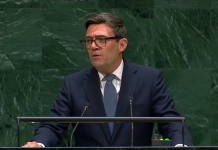
NATO deliberately refrains from publicly defining the exact threshold beyond which Article 5 of the North Atlantic Treaty may be invoked. According to the Alliance’s Secretary-General, Mark Rutte, this strategic ambiguity prevents potential adversaries from knowing exactly how far they can go.
Briefly about the main points
- NATO will not specify the exact conditions that could trigger the invocation of Article 5.
- Mark Rutte stated that this strategic ambiguity is deliberate.
- The Alliance has various options for responding to hybrid threats.
- Some of NATO’s potential measures will remain confidential.
- Article 5 provides for the collective defence of NATO member states.
NATO will not disclose the exact threshold for Article 5
NATO Secretary General Mark Rütte stated that the Alliance is deliberately leaving it unclear as to which specific actions by the adversary might constitute grounds for invoking Article 5.
According to him, NATO has no intention of informing potential adversaries of the exact limit up to which they can act without risking triggering the collective defence mechanism.
Rutte emphasised that this ambiguity would persist. At the same time, he stated that Russia has a fairly clear understanding of which actions could lead to serious consequences from the Alliance.
Some of NATO’s responses will remain confidential
The NATO Secretary-General also highlighted hybrid threats. According to him, the Alliance has all the necessary response options at its disposal, but by no means every response will be made public.
Rutte explained that NATO does not wish to provide its adversaries with further information about its capabilities and response mechanisms.
He had also noted previously that the Alliance’s response need not necessarily be a mirror image. Some measures may be symmetrical, whilst others may be asymmetrical. During a joint press conference in September, Rutte stated explicitly that some of NATO’s actions in response to hybrid threats would be visible, whilst others would remain behind closed doors.
What does Article 5 of the NATO Treaty provide for?
Article 5 The North Atlantic Treaty enshrines the principle of collective defence.
An armed attack against one or more NATO members is regarded as an attack against the entire Alliance. In such a case, each member state must come to the aid of the party under attack, taking whatever measures it deems necessary. This may include the use of armed force.
At the same time, NATO explicitly states that the question of whether a specific incident meets the criteria for an «armed attack» is assessed on a case-by-case basis. Major cyber-attacks and other serious hybrid attacks may also potentially be considered in the context of Article 5.
In the entire history of NATO, Article 5 has been officially invoked only once — following the terrorist attacks in the US on 11 September 2001.