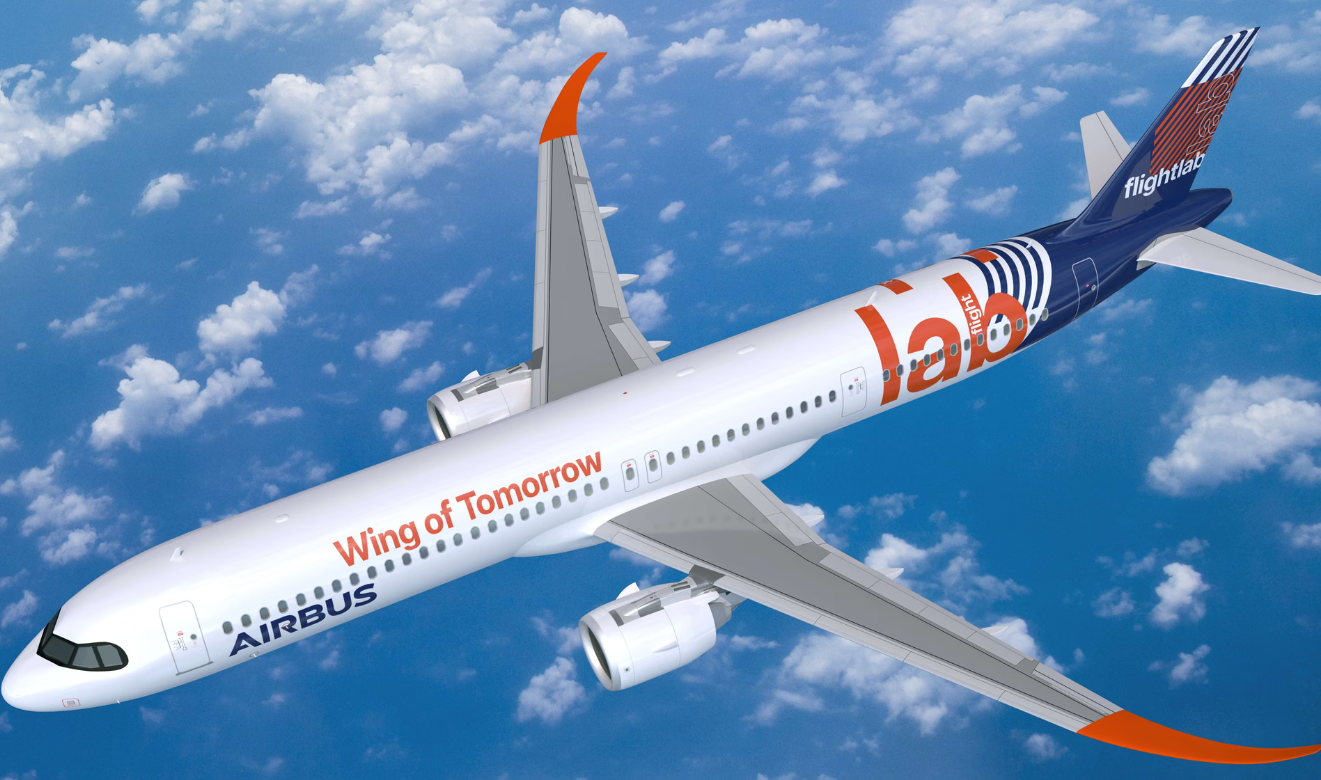
Airbus has announced the launch of a new phase of the Wing of Tomorrow programme: over the next three years, the company will design, manufacture and conduct in-flight tests of full-scale wing extensions on the A321neo. The tests in Toulouse are intended to demonstrate how a larger wingspan affects the aircraft’s behaviour, manoeuvrability and aerodynamic efficiency.
Briefly about the main points
- Airbus is launching a three-year programme of flight tests on the A321neo’s winglets.
- The wing sections will replicate the complex structure only when fully extended.
- Equipment for measuring in-flight behaviour will be installed on the aircraft.
- Production of the sections will be organised at the Wing Technology Development Centre in the UK.
- Airbus plans to finalise the design of the new aircraft by 2030.
What exactly will Airbus be checking?
Sections several metres long will be fitted to the A321neo to simulate the complex wing in its fully extended configuration. The company will fit them with measuring equipment to collect data on load, manoeuvrability and the impact of the increased wingspan on the aircraft under real flight conditions.
This is not about testing the hinged wing-folding mechanism. Airbus It is exploring a longer and slimmer wing, as this design, combined with lightweight and strong materials, can reduce energy consumption. At the same time, the increased wingspan poses a problem for operations at airports where space near the gates is limited.
From ground-based demonstrators to flight tests
The test sections will be manufactured at the Wing Technology Development Centre in the UK, whilst the flight-test phase of the programme will take place in Toulouse. At the same time, Airbus is finalising its digital modelling and wind tunnel testing.
Previously, as part of the Wing of Tomorrow programme, the company built three ground-based demonstrators of the 17-metre-long wing. These were used to test the increased wingspan and over 100 manufacturing and assembly technologies. Since 2014, the programme has received £227 million in funding through the UK’s Aerospace Technology Institute.
Separately, the Airbus UpNext division is developing the eXtra Performance WING demonstrator, which is capable of changing shape in flight. Its first remotely piloted flight in Cazaux, in the south of France, is scheduled for the end of 2026; this is a related but separate project.
The wing and the engine will determine the next model
Airbus plans to finalise the design of its new aircraft by 2030. The company is already working on the assumption that the next generation will feature relatively heavy, large-diameter engines, and that the wing will have a sweep similar to that of a seagull’s wing to provide additional aerodynamic benefits.
The manufacturer must also choose the engine architecture — with a closed fan or an open fan. The wing tests do not determine the final design of the future narrow-body aircraft, but are intended to reduce the technical risks associated with this choice. Airbus explicitly identifies the wing, alongside the engine, as one of the key factors in reducing fuel consumption.
Rolls-Royce is aiming to be part of the next generation
Rolls-Royce is developing the UltraFan 30 as a demonstrator for narrow-body aircraft and expects to build it by 2028. The company’s chief executive, Tufan Erginbilgic, stated in February that the manufacturer is not seeking a government loan, but is expecting competitive funding for research and technology.
Rolls-Royce estimates that its share of future expenditure under the partnership could range from 3 to 6 billion pounds over 12 years — depending on the number of engine variants and the extent to which components are shared. At the same time, the company reported free cash flow of £3.3 billion for 2025, net cash of £1.9 billion, and a share buy-back programme worth £7–9 billion for 2026–2028. This makes the question of the form of state support for research particularly relevant.