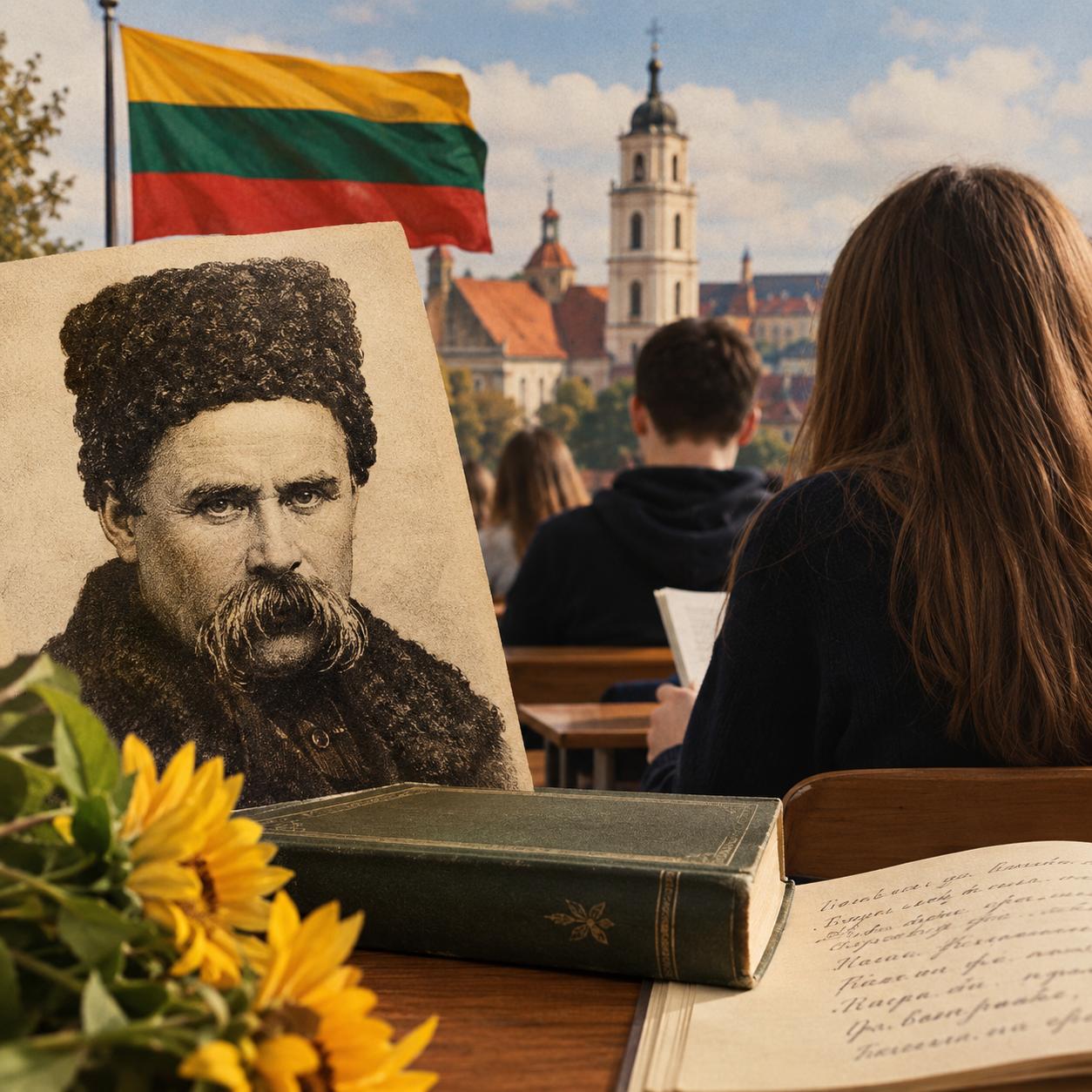
On 5 October, the Lithuanian Ministry of Education, Science and Sport announced that works by Taras Shevchenko would be included in the core curriculum for the Lithuanian language and literature. In the 2026/27 academic year, they will be recommended reading for Year 8 pupils and some grammar school pupils, and from 1 September 2027, the poet will become a compulsory author for Year 11 pupils on the advanced course.
Briefly about the main points
- Shevchenko has been included in the standard curriculum for Lithuanian language and literature.
- For Year 8 pupils and some grammar school pupils, the poet’s works are currently recommended.
- The advanced course for Year 11 will be a compulsory subject from September 2027.
- «The Testament» and the epistle «To the Dead and the Living…» have been added to the recommended list.
- Lomonosov and Derzhavin were removed from a separate curriculum for the Russian ethnic minority.
What pupils will study and how
This academic year teachers will be able to recommend works Shevchenko to pupils in Year 8 and Year 3 of the gymnasium who are following the general curriculum. Year 3 of the gymnasium in the Lithuanian education system corresponds to Year 11. Teachers They will also be entitled to select other works by Ukrainian authors themselves.
«The Testament» and the message «My friendly message to my fellow countrymen, both dead and alive, and those yet to be born, in Ukraine and beyond» have already been included in the recommended reading list. From September 2027, Shevchenko will be studied as a compulsory author by Year 3 pupils at grammar schools who have opted for the extended curriculum.
His poetry will be examined within the context of Romanticism. The teacher will decide which specific texts will be read on the advanced course. Therefore, the new rules do not mean that all Lithuanian school pupils are now required to study Shevchenko.
The Ministry attributes the decision to the cultural ties between Ukraine and Lithuania
Minister for Education, Science and Sport Raminta Popovene described Shevchenko as a writer of European calibre from the Romantic era. According to the ministry, his works provide an opportunity to discuss freedom, national identity, human dignity and cultural memory with pupils.
Among the reasons for the decision, the ministry also cites the strengthening of cultural ties between Lithuania and Ukraine, the integration of Ukrainian children studying in the country, and the development of a shared European identity. Shevchenko lived in Vilnius for several years and studied art there; there are places in the city associated with him.
Further context for including this author in the course on Romanticism is provided by his place in the syllabus alongside writers through whom pupils explore the identity of the historical peoples of Lithuania, in particular by Adam Mickiewicz, Tadeusz Bujnicki and Oskar Miloš.
Lomonosov and Derzhavin were removed from another subject
At the same time, in the 2026/27 academic year, Lithuania revised the Russian mother-tongue and literature curriculum for pupils belonging to the Russian national minority. Works were removed from the Year 9 curriculum Mikhail Lomonosov and Gavrila Derzhavin.
In August, the Prime Minister Mindaugas Sinkevičius He proposed removing Lomonosov from the syllabus, criticising his writings which glorified Russia’s imperial wars. The Ministry had previously announced its intention to review the entire list of authors and the values underpinning this course separately.
These changes affect various educational programmes: Shevchenko has been added to the general course in Lithuanian language and literature, whilst two Russian authors have been removed from the curriculum for the native Russian language and literature for the national minority.