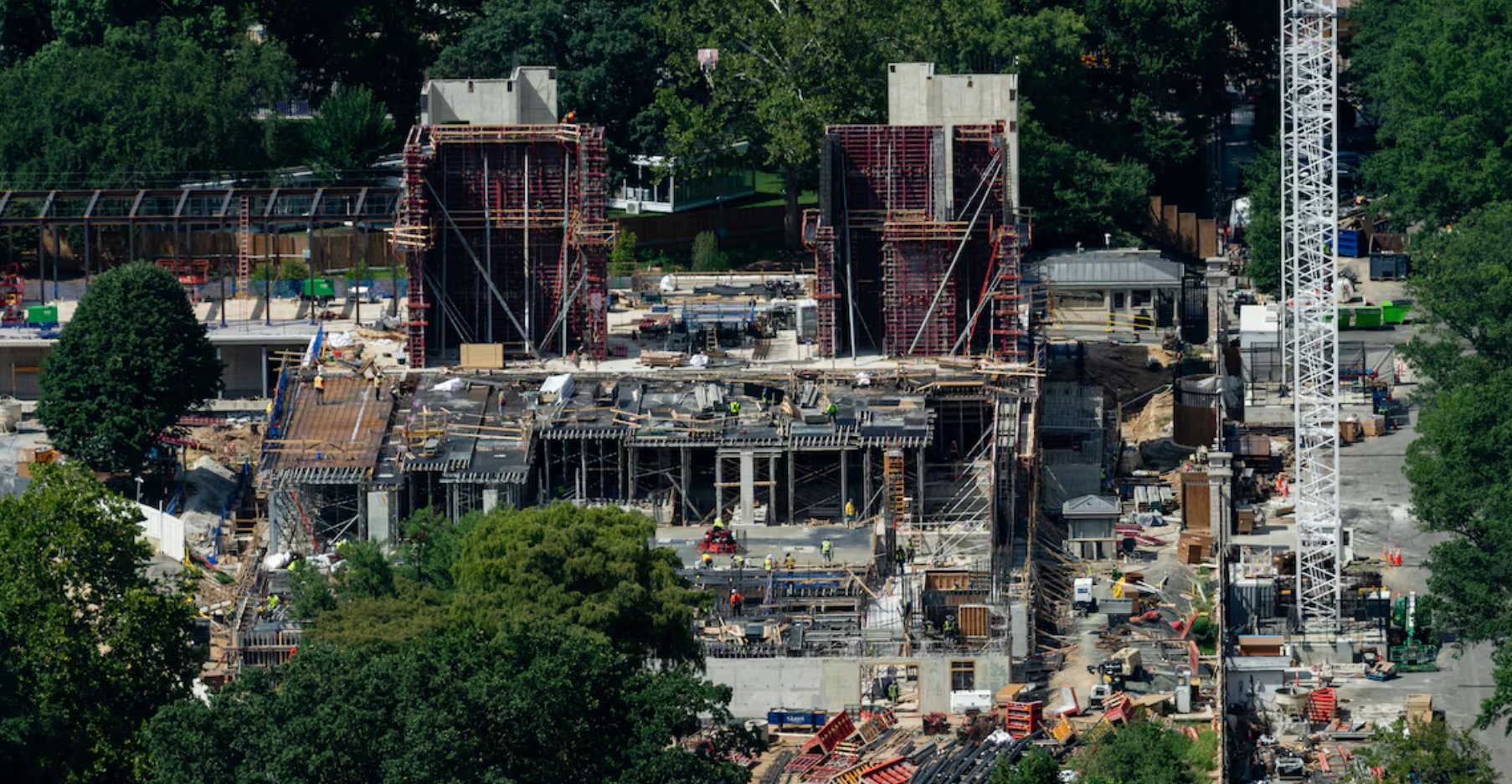
On 7 August, the Federal Court of Appeal in Washington upheld a preliminary injunction against the construction of a $400 million ballroom on the site of the demolished East Wing of the White House. The ruling was handed down by a 2-to-1 majority in response to a lawsuit brought by the National Trust for Historic Preservation. Its effect has been suspended for 14 days to allow Donald Trump’s administration to appeal to the US Supreme Court.
Briefly about the main points
- The Court of Appeal upheld the ban on the construction of the ballroom.
- The decision was passed by two votes to one.
- The administration has 14 days to appeal to the Supreme Court.
- The dispute centres on whether congressional authorisation is required for the construction.
- Judge Leon had previously only suspended work above ground.
What does the appeal court’s decision mean?
The Court of Appeals for the District of Columbia has upheld the preliminary injunction sought by the National Trust. The lawsuit was filed last year following the demolition of the East Wing and the start of work on a 90,000-square-foot, or 8,360-square-metre, extension.
District Court Judge Richard Leon It had previously blocked above-ground construction on two occasions, whilst allowing underground work to continue. The current ruling will not come into force immediately: the appeals panel has given the White House two weeks to lodge an appeal with the country’s highest court.
A dispute over congressional authorisation, not just about the design
The key issue in the case is whether the president had the legal authority to carry out such a large-scale project on federal property without specific approval from Congress. Leon argued that no federal law even comes close to granting the president such powers.
At the hearings in June, a representative of the Ministry of Justice Yakov Roth He argued that the courts should not assess a privately funded project and had no right to halt it. Taddeus Goyer, a lawyer for the National Trust, countered that the administration simply did not want to approach Congress.
The Fine Arts Commission had previously approved the design, whilst the National Capital Planning Commission had approved the site and building plans. However, these administrative approvals do not replace the statutory authorisation, which is the subject of the legal dispute.
The administration’s arguments and the next step
The administration described the permanent hall as essential for major official events and for the security of the White House. In court, Roth cited the argument that the former East Wing left the President and others in the residence vulnerable to attack.
Trump defended both the project itself and its budget, which had doubled compared with the initial estimates. Last month, he wrote on Truth Social that project will be roughly twice as large and of a higher quality, promising a «wonderful, safe and secure» result.
The administration has 14 days in which to ask the US Supreme Court to intervene in the case. Whether the appeal ban remains in force will depend on this move.